New Zealand Student Visa: How to Apply
28 Jan 2026
Many different visas allow you to study in New Zealand. You can attend school, take a short course, study for an extended period of time, or receive additional training. Whichever you choose, this guide on how to apply for a student visa in New Zealand will lead you to the one place you want – SUCCESS.
To study in New Zealand, most international students will need to obtain a valid student visa. You need a student visa if you are not a New Zealand or Australian citizen or resident, and you plan to study a course longer than three months; make sure you have your visa before entering the country.
Immigration New Zealand is the official authority for student visa applications. For more detailed information on student visa conditions, requirements, and work entitlements, you can also visit the Education New Zealand website and NauMai NZ, the official resource for international students.
Why Choose New Zealand as Your Study Destination?
If you’re considering where to study abroad, New Zealand stands out as a world-class destination for international students. With its globally recognized education system, breathtaking landscapes, and vibrant, multicultural society, New Zealand offers a unique blend of academic excellence and unforgettable life experiences.
To study in New Zealand, most international students will need to obtain a valid student visa. Immigration New Zealand is the official authority responsible for issuing student visas, and their website is the go-to source for up-to-date information on visa options, application requirements, and the conditions you’ll need to meet as a student. Whether you’re planning to enroll in a degree programme, a short course, or a research-based PhD, there’s a visa to suit your study goals.
Student Visa Application Checklist
To save you some time, we have made a Student Visa Application Checklist, which outlines the following documents required for the application process. In fact, the exact types of documents you need vary based on the specific requirement of your chosen visa.
| All applications for a Student Visa must contain | Submitted?****(Tick the box if YES) |
|---|---|
| A fully completed application form INZ 1012 | |
| Two recent passport-sized color photographs (must be less than 6 months old) attached to the application form | |
| Valid passport(s) (or certified true copy of the passports if the original one cannot be supplied) | |
| Visa application fee | |
| Student visa summary form | |
| Offer of Place from the Education Provider(s) in New Zealand | |
| Evidence of sufficient funds and genuine sources of income to cover tuition fees and maintenance expenses throughout the period of your intended stay in New Zealand. | |
| If your study is not financially supported by your parents, a fully completed Financial Undertaking Form INZ 1014 or Sponsorship Form INZ 1025 where applicable, and evidence of your relationship with the sponsor/third party providing the financial undertaking | |
| Evidence of qualifications or training attained/enrolled and study records. Evidence of current work/employment | |
| e-Medical information sheet issued by one of our appointed panel doctors listing Chest X-Ray Certificate (INZ 1096) completed, if you are full-fee paying student intending to stay in New Zealand for 6 months or more | |
| Police certificate from country of your citizenship and from any country in which you have lived for 5 years or more since attaining the age of 17 years (for applicants intending a stay for 24 months or longer) | |
Note: Immigration New Zealand may seek additional information or supporting documentation during the application assessment process and keep it on file. Depending on your individual circumstances, you may be asked to provide further supporting documentation to verify the information in your application.
Step-by-Step Timeline: From Choosing a Course to Getting a Visa Decision
Let’s take a look at the step-by-step timeline when applying for a student visa in New Zealand:
- Step 1: Find your course and university/college
- Step 2: Apply for admission & Wait for the Offer Letter
- Step 3: Confirm your Offer of Place & Pay the tuition fees. You must also complete your enrolment with the education provider as part of the official process.
- Step 4: Research student visas and choose the one that works best for you
- Step 5: Create a RealMe account to apply for your Student Visa online
- Step 6: Check the requirements & Gather all the necessary supporting documents
- Step 7: Pay the application fees
- Step 8: Submit your application
- Step 9: Keep track of your visa application status & Wait for results
- Step 10: Immigration New Zealand will email you when the decision is made
Related article : The Best Universities in New Zealand for International Students
Types of student visas in New Zealand
Fee Paying Student Visa
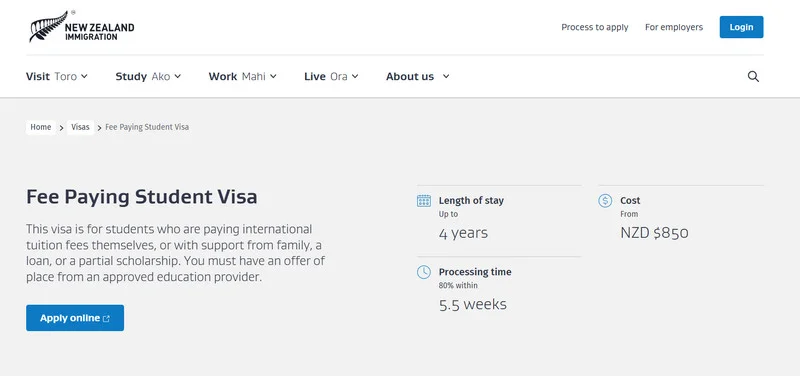
The Fee Paying Student Visa is the most popular type for international students entering New Zealand. It is the main New Zealand student visa you must apply for if you plan to study full-time in the country. To be eligible for this visa, you must be accepted by an approved education provider. This student visa permits you to study full-time and, in some situations, work up to 20 hours part-time throughout the academic year and full-time during scheduled breaks.
Pathway Student Visa
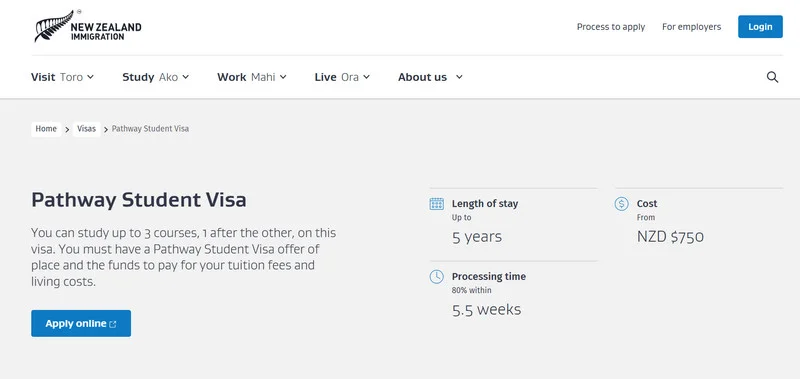
The Pathway Student Visa enables you to study multiple degrees in New Zealand. Specifically, you can study up to three consecutive programs over a maximum of five years, which simplifies the procedure of switching between courses. Each programme of study must be specified in your visa application. Moreover, you can work part-time (20 hours per week) while studying and full-time during planned breaks.
Exchange Student Visa
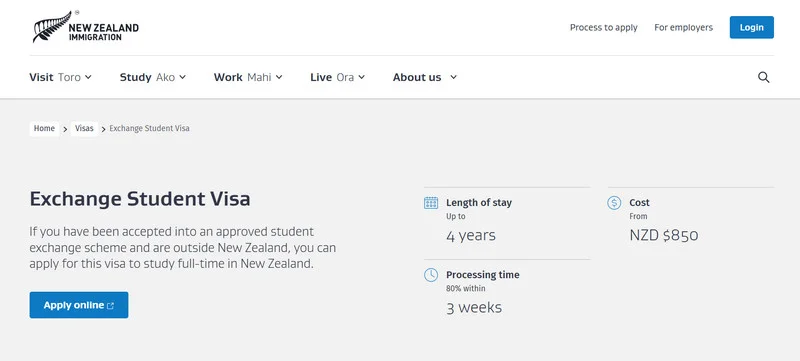
If you have been admitted into an authorized student exchange program and do not reside in New Zealand, you can apply for this visa to pursue your education full-time in New Zealand.
Students from an overseas university participating in an official exchange program should apply for an Exchange Student Visa, while a study abroad student follows a different application process. Be sure to check your Offer of Place to confirm your student status.
This visa allows you to study full-time in New Zealand through a school-to-school exchange, an exchange program organization plan, or a tertiary exchange. Furthermore, depending on your age and duration of study, you can work part-time for up to 25 hours per week while studying or full-time during the holidays.
Other Study Options (Short courses / school-aged / special cases)
In addition to the 3 main visa types above, you can opt for other options based on your study programs and its duration.
- Temporary visas (Visitor visa or Work visa): If you wish to attend a short course of study in New Zealand, these visas may be the best option for you. A visit visa, for example, allows you to take one or more short courses totaling up to three months or a school term. In some cases, you may be required to provide an official Offer of Place letter (place letter) as evidence of your enrollment.
- NZeTA (New Zealand Electronic Travel Authority): If you are from a visa-waiver nation, you do not need to apply for a visiting visa before traveling. However, you must apply for a NZeTA. When you arrive, you will be issued a guest visa, which will allow you to attend one or more short courses for up to three months, or a school term.
- Working holiday visas: You can apply for a working holiday visa if you are between the ages of 18 and 30, or 18 and 35 in a few countries, and are a citizen of a country with which New Zealand has a working holiday agreement. A working holiday visa allows you to pursue one or more courses in New Zealand for up to six months. For example, you could study English, participate in a Study Abroad program, or take a brief training course. You must be here primarily for vacation; study should be a secondary goal.
When Do You Need a New Zealand Student Visa?
Studying 3 Months or Less
You do not require a student visa to study in New Zealand, if you are:
- New Zealand citizen or resident; Australian citizen or Australian permanent resident visa holder — without conditions
- Enrolling in a short course lasting less than 3 months BUT MUST HAVE a Visitor visa, Work visa or NZeTA
If you need a visa, make sure to apply for your visa directly through the official Immigration New Zealand website.
Studying More Than 3 Months
If your study lasts more than 3 months, you must apply for a student visa via the standard method, with 3 main options that allow you to study full time in New Zealand:
- Fee Paying Student Visa
- Pathway Student Visa
- Dependent Child Student Visa
You should begin your student visa apply process as soon as you receive your Offer of Place from a New Zealand education provider. Applying early helps ensure you have enough time to gather documents, avoid delays, and reduce the risk of issues during the application process.
Besides, there are other student visas available for people from specified countries or who are coming to study for a specific reason.
Before You Apply for a Student Visa: What to Prepare?
Get Accepted & Secure Your Offer of Place
First and foremost, you need to decide the student visa option to apply for, which is mainly based on your circumstances and intended study plans. Thus, research what subject you want to study and how long the course is, to get the best visa.
When you have decided on your course, you must apply for your place to study with that education provider. When you are accepted by an education provider, you will receive an Offer of Place. You will need this offer to apply for a student visa.
Tuition Fees: Proof You’ve Paid / Can Pay
Along with the Offer of Place, you will need to keep an official receipt or confirmation letter from your New Zealand education provider stating fees are paid or will be paid. Besides, you can provide other documents that show you are able to cover the tuition fees down the road. They could be:
- Bank Statements with evidence of sufficient personal savings for tuition fees
- Scholarship letter or Loan documents to you have successfully applied for a grant or a loan to cover the fees
- Approval in Principle (AIP), which allows you to pay fees and provide the receipt before the final visa grant
Financial Requirements: Evidence of Funds
Tuition fees are not the only expenses you need to pay when studying in New Zealand. There are various studying and living costs you need to cover. Therefore, the Immigration NZ requires you to provide Evidence of Funds to make sure you can fulfill your financial requirements.
In your student visa application, you have to:
- Demonstrate you have enough money to support yourself while studying in New Zealand
- Include proof of where this money has come from: Bank statements, Proof of scholarship or A financial undertaking document which proves that a sponsor will cover your costs.
In some situations, you may also be required to provide documentation that you intend to leave the country after completing your study.
As for how much funds are needed, you can decide based on the length of your study and the location you choose. Therefore, it is critical to conduct thorough research on how much your desired degree will cost.
Health requirements for a student visa
You must be healthy to obtain a student visa in New Zealand. Depending on where you are from and how long you intend to remain, you may be required to provide health certifications along with your application.
When you apply, you will be asked about your medical background. You may need to undergo a medical examination or provide additional medical certificates based on:
- Whether you are a domestic student or an international fee-paying student
- Where you come from
- Where you have been living
- How long you want to stay in New Zealand
Some common medical tests are:
- Chest X-ray: If you are a citizen of a nation with a high prevalence of tuberculosis or have recently visited that country, you will be tested for the disease.
- Blood tests: It is required to screen for infectious diseases like HIV and hepatitis.
- Physical examination: This is to evaluate your overall health and determine if you have any potential medical issues that may affect your eligibility for a student visa.
Your medical certificates must be less than three months old and delivered electronically to INZ in most circumstances. Overall, your visa application may be denied if the expense of your healthcare is exorbitant.
Character requirements for a student visa
If you are 17 years or older and intend to study in New Zealand for more than two years, you must additionally present police clearance certificates from any nation where you have lived for 12 months or more in the previous ten years. This demonstrates that you have a decent character and are not a threat to New Zealand’s safety and security.
You will need to obtain a police certificate from your country of citizenship, and any country you’ve lived in for longer than 5 years since you turned 17. The certificates must be less than 6 months old when submitted to Immigration New Zealand
English Language Requirements
Since English is the major language of instruction in New Zealand, demonstrating your proficiency is an important New Zealand student visa requirement. You will usually need to acquire a minimum score on an approved English language test, such as IELTS, PTE, etc. The particular score required varies depending on your course and institution.
Importantly, New Zealand has announced a stricter rule for English Language Requirements for certain visas. The reasons behind this move are to make sure the students have the required linguistic skills and reflect a higher demand for skilled professionals.
For more information: Changes To New Zealand Language Test Requirements: What’s New?
Guide to apply for a New Zealand student visa
Create Your Online Account (RealMe) & Apply Online
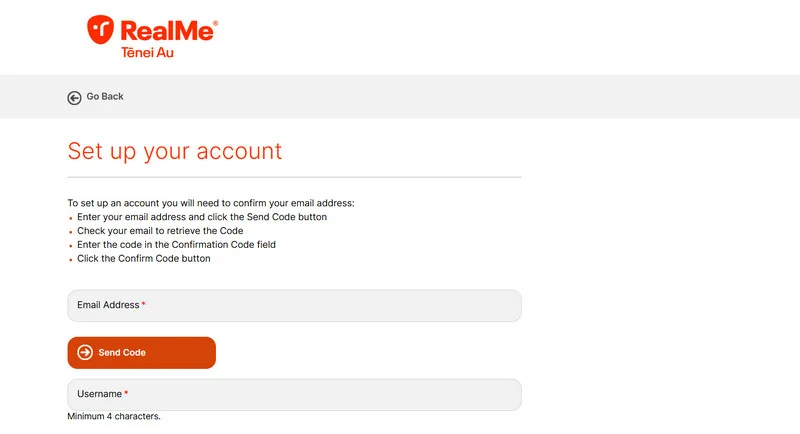
You can apply for most visas online. This includes submitting paperwork, photos, and paying application fees. When you submit an online application, you must create a New Zealand Government RealMe account.
RealMe® is a government-provided identification and identity verification service. This account allows you to log into a variety of New Zealand government and public sector websites and services. It is also a secure way to prove your identity online.
Fees, Where to Apply, and How to Pay
Once you have the RealMe account, let’s decide which visa to apply for. You can look out the requirements for each visa, as well as the application process and estimated time of completion. You can use the Immigration NZ’s visa search and comparison tool to find and compare visas. After you locate your preferred visa, you can hit the “Apply online” button right on the page. For the most up-to-date information on visa types, requirements, and application procedures, always visit the official Immigration New Zealand website.
One of the information requirements to pay attention to is the application fee, which varies based on your visa type. For example, the Fee Paying Student Visa costs from NZD $850 per application. You can pay by credit card (Mastercard, Visa or UnionPay).
Upload Documents & Submit Application
Based on the requirements of your visa and situation, you can start gathering all the necessary documents. Normally, you will need to provide:
- A photo of yourself that meets the requirements for visa photos
- Medical & Police certificates in English
- Any other supporting documents in English, as well as the original or certified copies of those documents
For photo requirements, you must provide a photo of yourself with a full-front view of your face in your application. Visa photographs must meet precise conditions, such as no smiling and no hair concealing your face. Furthermore, images must be in JPG or JPEG format. The photo must be uploaded as a JPG file.
All documents uploaded must be in PDF format. They must be uploaded as a single file. For example, if your bank statement has four pages, it must be uploaded as one file rather than four distinct files. Try not to upload multiple copies of the same document.
Upload all the required documents correctly to finish your online application submission, then you can pay the fees and wait for the outcome.
After You Apply
All you need to do now is wait and actively check your visa status. In fact, you do not need to do anything else after submitting your application. They will contact you if they require additional information from you, which could be:
- Other photographs, documents or information
- Evidence of your onward travel, such as plane tickets
- A medical examination
- Confirmation to attend an interview with them
If you do not provide all of the information required to support your application, they may take longer to process it or decide not to issue you a visa.
How Long It Takes (Student visa wait times + planning guidance)
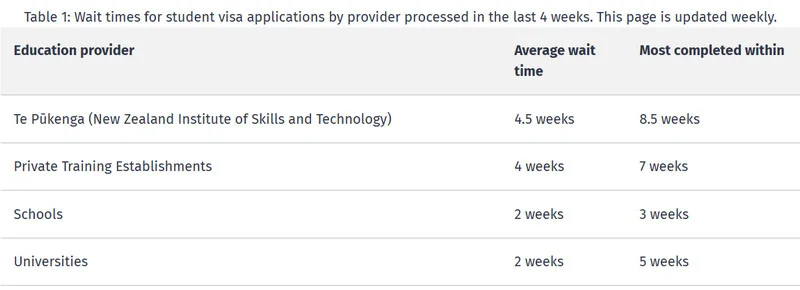
The length of your wait for a visa decision is determined by a variety of factors, including:
- Which visa you applied for
- Where you apply from
- How many other visa applications we have received
You can look for the time estimate on each visa page. For example, the processing time for Fee Paying Student Visa is mostly 5.5 weeks, excluding Saturdays, Sundays and public holidays.
However, they state that there are a large number of applications between October and March. This means that it may take longer to process your visa application during this period. Hence, overseas students should apply three months before their anticipated travel date to avoid delays.
Tips to Obtain a New Zealand Student Visa Successfully

Navigating the student visa application procedure for international students may be difficult, and even small errors can result in costly delays or outright denials. Yet, you can steer clear of them as long as you are well-prepared with some strategies to get everything done smoothly in the first attempt.
- Apply at the right time: As we’ve just mentioned, the busiest months for student visa processing are between October and March. Thus, you should choose other times than these months to start your application. Besides, it is always best to begin applying well in advance to account for processing time and unforeseen delays.
- Submit a complete and accurate application: Make sure that all essential documents are included in your application, and that they are correct and full. Translate papers if necessary. Any missing or incorrect information may result in delays or even rejection of your application.
- Demonstrate your genuine intention: You need to showcase your authentic interest in pursuing education in New Zealand. Craft a personalized cover letter that highlights your academic goals and how you plan to achieve them. Besides, explain how you intend to use the information you have received to benefit your native country after graduation.
- Provide proof of return: You can submit evidence such as a return flight ticket or ties to your home country (e.g. employment, property, or family commitments).
- Tip for scholarship applicants: If you are applying for a government scholarship, especially those funded by the Ministry of Foreign Affairs and Trade (MFAT), consult the Ministry of Foreign Affairs for specific student visa requirements related to your scholarship. This ensures you meet all eligibility criteria and avoid delays.
Renew Your Student Visa: What to Do?
Most student visas are valid for the duration of your term, however this is not always the case. If your visa expires before your study is completed, you will need to apply for a new student visa. It is important to apply for a new visa before your current visa expires to maintain lawful status in New Zealand. Without a valid student visa, you will have to leave New Zealand before your current visa ends.
Remember to apply well before your existing visa expires. If your current visa expires while your application for a new visa is being processed, Immigration New Zealand may grant you an interim visa, which allows you to stay lawfully in the country until a decision is made.
When you apply, you will be required to give evidence, which you can acquire from your education provider, including:
- Your previous performance as a student
- Your attendance, if it has been recorded
- An assessment of your progress from your education provider
Returning students must provide updated evidence and should check the end date of their previous visa to ensure compliance with visa conditions and passport validity.
All applications must be submitted online via your RealMe account as a paper application is no longer accepted
Working While on a Student Visa: Your Rights & Responsibilities
International students in New Zealand may be eligible to work while on their student visas. The eVisa or visa sticker in your passport indicates if you can work. According to the rules, tertiary students, such as university or polytechnic students, may be eligible to work part-time during the semester and full-time during the holidays, such as university holidays.
Importantly, new adjustments to students working on student visa policies have gone into effect. Starting November 3, 2025, the number of hours qualified student visa holders can work per week has increased from 20 to 25. This is applicable to all new student visas. Students with a 20-hour work limit may seek for an additional 5 hours under certain conditions or apply for a new student visa.
Aside from the rights to work, you will have to bear the responsibilities, such as:
- Get an IRD (Inland Revenue) number if you’re going to work.
- Must not be self-employed; you must have an employment agreement with your employer.
- Must not offer commercial sexual services.
Working while your visa prohibits is a violation of your visa terms. This results in deportation and adverse impact on any of your future visa applications.
Working in New Zealand after Your Studies Have Finished

You could potentially stay and work in New Zealand after finishing your studies. To do so, you will require a work visa. If you meet the qualifications, you can apply for a Post-Study Work Visa, which allows you to stay and work in the country.
Your qualifications will determine how long you can remain and what type of employment you can do. For instance, a degree level 7 or higher, earned after at least 30 weeks of full-time study, permits you to work for any firm and in practically any field.
You may also be qualified for more particular work visas, depending on your situation, talents, and job offer (if any).
Importantly, studying for qualifications in an occupation where there is a skill shortage may improve your chances of landing a job. The “Green List” is a list of in-demand jobs. If your job is mentioned and you meet the eligibility, registration, or experience requirements, you may be able to obtain residency immediately or after 2 years of employment here.
Conclusion
While the procedure to apply for student visas in any country may be difficult, all you need is careful planning and proper help. Thus, learning all the key steps on how to apply for a student visa in New Zealand well in advance will give you a better chance at winning the approval the first time.
Don’t let the visa process stop you from enjoying the unique opportunity to gain a world-class education and immersing yourself in the stunning natural environment and vibrant culture of New Zealand.
FAQs
1. What are the specific scores to meet the English Language Requirements for a student visa in New Zealand?
Here is a look at the accepted English test scores for Student Visas & Tertiary Pathway:
- IELTS (Academic, General, or One Skill Retake): Minimum overall score of 5.5 for visa application, 6.0 (no band below 5.5) for Undergraduate Admission & 6.5 (no band below 6.0) for Postgraduate Admission
- TOEFL iBT: Minimum overall score of around 90 (Writing 21) for Postgraduate Admission or 80 for Undergraduate Admission
- PTE Academic: Minimum overall score of around 58 – 64 for Undergraduate Admission or 65 – 90 for Postgraduate Admission
- Cambridge English (C1 Advanced/CAE): Minimum overall score of 169 (no band below 162)
2. Do I have to attend visa interviews?
In some situations, you may be invited to an interview at a New Zealand visa application centre. The interview allows immigration officials to judge your real desire to study and your grasp of the program you’ve chosen. Prepare for the interview by examining your application and being prepared to answer questions about your academic plans and future goals.

Moni Vuong
PTE Magic
My name is Moni, and I am a seasoned PTE teacher with over 6 years of experience. I have helped thousands of students overcome their struggles and achieve their desired scores. My passion for teaching and dedication to my student’s success drives me to continually improve my teaching methods and provide the best possible support. Join me on this journey toward PTE success!
Related Blog
02 Sept 2026
PTE Essay Topics 2026: 60 Questions
02 Sept 2026
PTE Exam Pattern 2026: Full Test Structure
02 Sept 2026
PTE Summarize Group Discussion Template
Frequently Asked Questions
What’s the difference between PTE Academic and PTE Core?
What is PTE Exam Structure and Duration?
How is PTE exam scored?
What tasks are included in PTE Academic?
What tasks are included in PTE Core?
How long is the score valid?
Where can I book PTE Academic and PTE Core exams?
How much does the PTE exam cost?
How can I prepare for the PTE Exam?
Subscribe to our newsletter.

PTE Magic Practice Platform is an AI-powered PTE test prep platform that helps you achieve your desired score with exam-like questions, instant AI scoring, and personalised feedback. Achieve your best PTE score with targeted practice and proven strategies.