Changes To New Zealand Language Test Requirements: What’s New?
28 Jan 2026
If you are planning to migrate, study, or work in New Zealand in 2026, there are changes to New Zealand language test requirements that apply to nearly all visa categories. This is a big change that may affect your eligibility. Update your information and prepare to prevent visa delays or rejections due to language competency concerns.
New Zealand Language Proficiency Requirements
If you want to study or work overseas in New Zealand, you must now demonstrate your English language skills. Many documents are acknowledged by Immigration New Zealand (INZ) as proof of your English language skills for visa applications and admission to all New Zealand universities.
Applicants must meet specific eligibility requirements for English language proficiency, which outline the criteria and documentation needed to qualify for visas or university admission.
A high test score can help you improve your immigration profile by demonstrating an acceptable level of English proficiency. Strong English abilities are also essential for succeeding in your chosen industry and fitting into New Zealand society.
Acceptable Proof of English Language Proficiency
To meet the new requirements, applicants must provide evidence of their English language proficiency using one of the following accepted methods:
- Approved English language tests: IELTS, TOEFL iBT, PTE Academic, B2 First, B2 First for Schools, and OET (designed for health care professionals)
- NCEA Level 3 with New Zealand University Entrance
- A Cambridge A-level qualification or International Baccalaureate Diploma taught and assessed in English
- The Cambridge Certificate in Teaching English to Speakers of Other Languages (CELTA) or the Trinity College London Certificate in Teaching English to Speakers of Other Languages (CertTESOL)
- A degree, certificate or diploma with English as the language of instruction from a tertiary education provider from certain countries
- Prior schooling in New Zealand, Australia, Canada, Fiji, the Republic of Ireland, Kiribati, Nauru, Papua New Guinea, Samoa, Solomon Islands, South Africa, Tonga, Tuvalu, the United Kingdom, the United States or Vanuatu, with English as the language of instruction
The English Language Policy Changes for Each Visa Pathway
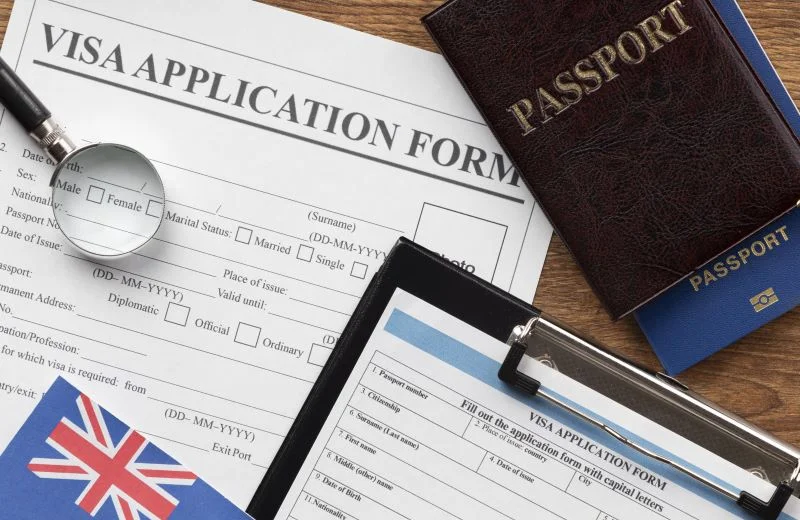
New Zealand has implemented more stringent and standardized English language standards across several visa categories. These changes are intended to guarantee that migrants, students, and workers can successfully integrate into society and meet the demands of studying, working, and living in an English-speaking environment in the country. The new language test requirements apply to applications submitted after the official policy change date, so requirements may differ depending on when your application is submitted.
Related article : PTE For New Zealand: Everything You Need to Know
In this section, we will go into detail to see which changes apply to which visa pathway.
Skilled Residence Visas
You must demonstrate that you, your partner, and any dependent children can speak and understand English when applying for the skilled resident visas listed below:
- Care Workforce Work to Residence Visa
- Skilled Migrant Category Resident Visa
- Straight to Residence Visa
- Transport Work to Residence Visa
- Work to Residence Visa
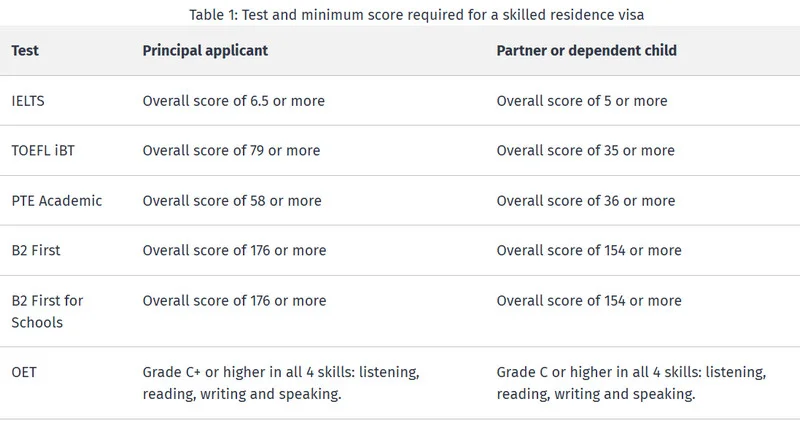
A skilled residence visa requires a greater level of English proficiency than other types of residence visas. If you are the person submitting the application (the principal applicant), there are two ways to demonstrate that you can speak and understand English:
- With your English ability from citizenship, working, and studying
- Citizenship combined with appropriate job or study experience in an eligible English-speaking country such as the United Kingdom, the United States, Canada, Ireland, Australia, or New Zealand.
- An accredited academic qualification (Level 7 or higher), such as a bachelor’s degree, taught in English. Completion of the bachelor’s degree (or higher qualification) is required for it to be accepted as proof.
- By taking an IN-PERSON English language test
What Changed (Compared to Previous Settings)?
Relying on your English-speaking background, nationality, or professional experience is no longer sufficient. In the past, you could choose either way to prove your English skill.
But now, though you can utilize your citizenship, work or study experience as evidence, Immigration NZ may still request a test. Therefore, it is better to sit an English exam in advance.
Partner & Dependent Children (16+) Requirements
For your partner and dependent children aged 16 or older, there are 3 ways to show that they can speak and understand English, including:
- Using their citizenship, working, and studying experience
- Using English language test scores (Check the table above)
- Purchasing English for Speakers of Other Languages (ESOL) tuition packages
Note: There are no English language requirements for children under the age of 16.
Accredited Employer Work Visa (AEWV)
When English Is Required?
When applying for an AEWV or a job at ANZSCO (Australian and New Zealand Standard Classification of Occupations) level 4 or 5, you now face stricter English language requirements. Moreover, online or home-based test formats are not permitted under the 2025 AEWV guidelines.
Yet, there are no English language requirements if you are applying for an AEWV for a job that is either:
- At ANZSCO level 1 to 3, or
- Included in the list of National Occupation List (NOL) occupations that can be used for an AEWV or Specific Purpose or Work Visa (SPWV).
Accepted Methods to Meet the English Language Requirements
If you are applying for an AEWV, there are two ways to demonstrate that you speak and understand English:
- With your English ability from citizenship, working, and studying
- Citizenship combined with 5 years of work or study in one of the eligible English-speaking countries such as the United Kingdom, the United States, Canada, Ireland, Australia, or New Zealand.
- A qualification that is comparable with a New Zealand level 7 bachelor’s degree or a New Zealand postgraduate qualification at level 8 or above, gained in countries like Australia, Canada, Ireland, New Zealand, United Kingdom and United States.
- By taking an IN-PERSON English language test
Student Visas & Tertiary Pathway
As an international student, you can obtain permission to study in New Zealand with the 2 types of student visas: Fee-Paying Student Visa or Pathway Student Visa.
If your first language is not English, you must provide proof of English proficiency as part of your application.
To get one of these New Zealand student visas, you need an offer from an approved school. And the offer of a place must include a declaration signed by your education provider to say they have assessed, and are satisfied that you have the English language ability, along with academic capability, to pass the course. In many cases, completion of previous studies may also be required as part of the admission process.
Though the evidence of English language test results are not mandatory, it can help the authority to assess your genuine intention to study. Moreover, in this case, the English language proficiency is often required and specified by your education provider.
Here is a look at the accepted English test scores for Student Visas & Tertiary Pathway. Applicants must achieve the required grade in each skill area:
- IELTS (Academic, General, or One Skill Retake): Minimum overall score of 5.5 for visa application, 6.0 (no band below 5.5) for Undergraduate Admission & 6.5 (no band below 6.0) for Postgraduate Admission. IELTS requirements may vary for different programs, so check the specific criteria for your course. With the IELTS One Skill Retake, you can retake individual sections such as listening to improve your score.
- TOEFL iBT: Minimum overall score of around 90 (Writing 21) for Postgraduate Admission or 80 for Undergraduate Admission
- PTE Academic: Minimum overall score of around 58 – 64 for Undergraduate Admission or 65 – 90 for Postgraduate Admission
- Cambridge English (C1 Advanced/CAE): Minimum overall score of 169 (no band below 162)
Entrepreneur & Business New Zealand Visas
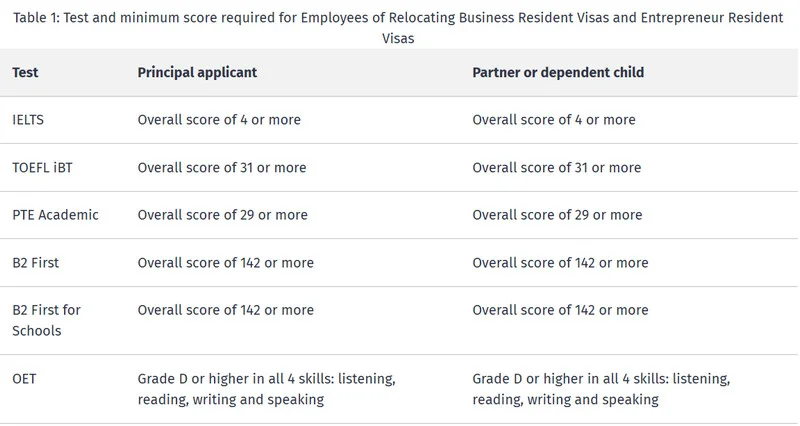
When you are applying for a Entrepreneur Resident Visa or Employees of Relocating Business Resident Visa, you must demonstrate that you, your partner and any dependent children can speak and understand English.
If you are the person submitting the application (the principal applicant), there are three ways to demonstrate that you speak and understand English:
- With your English-speaking background
- Education and qualifications
- Use of English in your work, family and everyday life
- With other evidence of your English language ability
- The country or countries you live in or used to live in, and how long you were there for
- Whether you or your family speak English or any other languages
- Whether English language was needed in your current and past work, and at what level
- Getting qualifications that needed skill in English language
- By submitting IN-PERSON test scores
Parent & Dependent Family Members Resident Visa
When you are applying for a Parent Resident Visa or Dependent Child Resident Visa, there are 3 ways you can show us that you speak and understand English:
- With your English-speaking background
- Education and qualifications
- Use of English in your work, family and everyday life
- By submitting IN-PERSON test scores
- Test and minimum score required for children of skilled residence visa applicants. (Note: Children of business visa holders has lower requirement for English test scores)
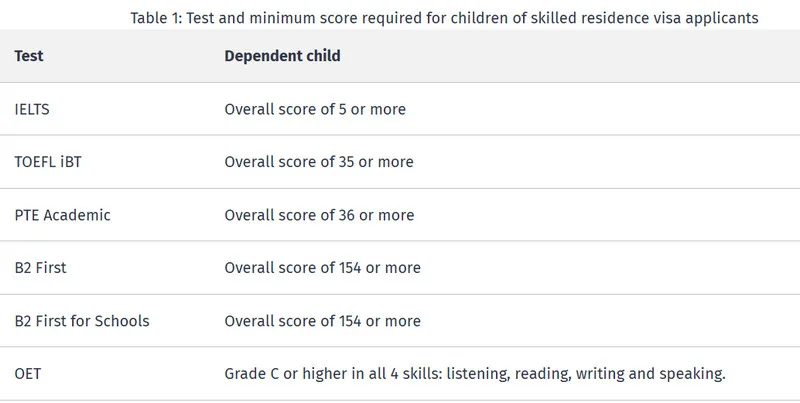
- Test and minimum score required for Parent Resident Visa
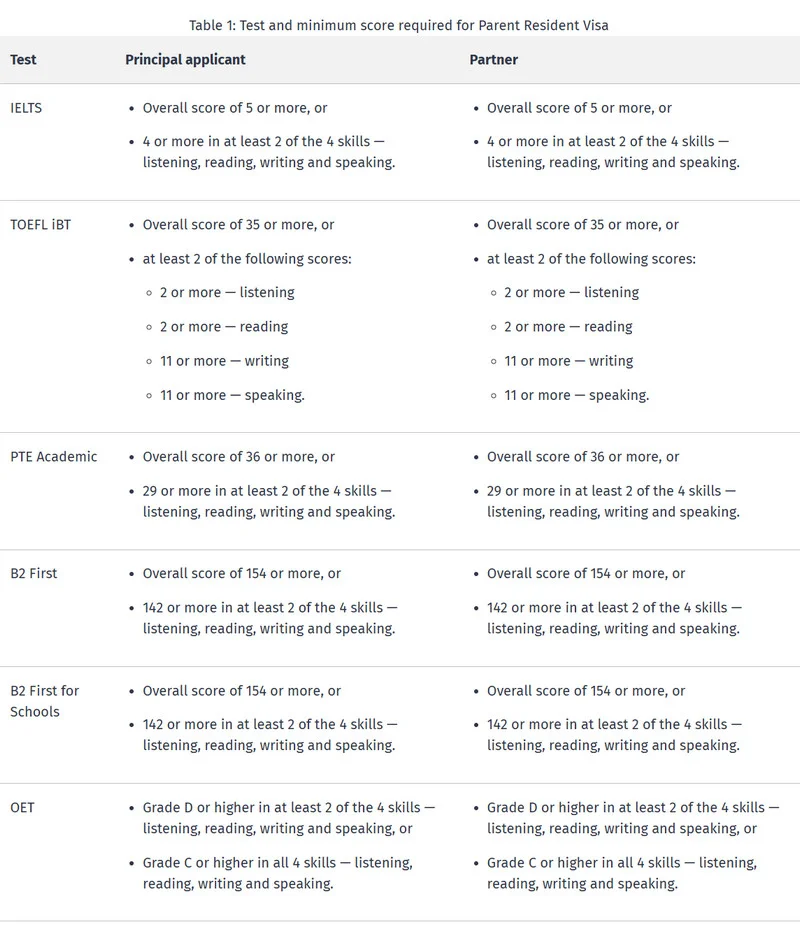
- By paying for lessons in New Zealand: If your partner or dependent children (16+) do not meet English language requirements through tests or citizenship, you can now purchase English for Speakers of Other Languages (ESOL) tuition packages as part of your application, paying Immigration NZ (INZ) for lessons they will take in NZ to improve their English after arrival.
Active Investor Plus Visa
New Zealand announced major changes to its Active Investor Plus Visa program on Sunday, including the removal of English language proficiency requirements. Furthermore, the partner or children of someone seeking for an Active Investor Plus Visa do not need to meet any English language requirements.
Occupation-Specific English Language Requirements
English language requirements in New Zealand are not one-size-fits-all—especially when it comes to certain occupations. The New Zealand government has set occupation-specific English language proficiency standards to ensure that workers can perform their roles safely and effectively, particularly in sectors where communication is critical.
For example, if you are applying for an Accredited Employer Work Visa (AEWV) in fields such as healthcare, education, or other regulated professions, you may be required to demonstrate a higher level of English language proficiency than applicants in other industries. This is because roles in these sectors often involve direct interaction with the public, compliance with safety protocols, and the need to understand complex information in English.
The required level of English for each occupation is determined by the nature of the job and the level of responsibility involved. For instance, healthcare professionals must meet strict English language requirements to ensure patient safety and clear communication with colleagues and patients. Similarly, teachers and educators must have a strong command of English to deliver lessons and support students effectively.
Applicants should carefully review the specific English language requirements for their intended occupation before applying for a visa. Accredited employers may also set their own minimum standards, in addition to those mandated by the New Zealand government, to ensure that all employees can meet the demands of their roles.
By meeting the occupation-specific English language requirements, you not only improve your eligibility for a New Zealand visa but also set yourself up for success in your chosen career. Always check the latest guidelines for your occupation and visa type to ensure you achieve the required level of English proficiency.
Key Changes in English Language Requirement Policies
Overall, there are different changes which apply to all or certain visa types. Here are the key changes in NZ’s in English Language Policy:
- Increased Minimum English Test Results (especially for ANZSCO Level 4 and 5 Occupations): Visa applicants must now attain higher scores on authorized English language tests such as IELTS, TOEFL iBT, and PTE Academic (taken within the last 2 years), based on the visa type.
- Less Dependence on English-Speaking Background Only: Visa applicants can no longer declare English proficiency just by residing in or coming from an English-speaking nation. Instead, formal test results are now required for most important visas.
- In-Person Test Sitting Only: Home-based and online test scores will no longer be accepted. New Zealand now requires results from monitored in-person examination centers.
- New English Support Programs for Families: Visa applicants have the option to buy English language tuition packages for their partners and dependent children as part of the visa application process, which promotes whole-family integration.
- English Requirement Elimination: Active Investor Plus Visa applicants are no longer required to fulfill the language requirements. This change happens due to the drop in the program’s applications and in average annual revenue overall.
- Case-by-Case Basis Assessments: In certain circumstances, English language proficiency may still be assessed on a case-by-case basis, depending on the applicant’s background.
What Has NOT Changed in Language Requirement Policies
Though there are a lot of major updates to the English proficiency rules, you can relax to know that some main criteria stay the same. Here is what has not changed (so you don’t misinterpret updates):
New Zealand English Test-specific Criteria
As we have mentioned, you can use your standardized English test scores as evidence for your language proficiency. There are some important rules about this method that you need to pay attention to make sure your English test score is valid.
Accepted English Tests & Versions
To be eligible, you can take one of the following English language tests:
- General or Academic module — International English Language Testing System (IELTS)
- One Skill Retake (OSR) — International English Language Testing System (IELTS)
- Test of English as a Foreign Language Internet-Based Test (TOEFL iBT)
- Pearson Test of English Academic (PTE Academic)
- B2 First — Cambridge English (B2 First)
- B2 First for Schools — Cambridge English (B2 First for Schools)
- Occupational English Test (OET) — designed for health care professionals
Normally, the principal applicant must have a higher test result than their partner or any dependent children over the age of 16.
In-Person Test Rule & Validity Window
You can select which test to take. However, regardless of your decision, you must take the test in person at a test center, and your results must be no older than two years at the time you apply. Remote tests, also known as ‘at home’ tests, are not accepted.
For example:
- The Cambridge English Qualifications must be taken in an approved exam centre, school, or other location. All test scores must come from a single Statement of Results.
- The IELTS test must be taken at an official IELTS testing center. The scores must come from a single Test Report Form.
- The LanguageCert test must be taken in a LanguageCert-approved testing center. All test scores must come from a single Test Report. International ESOL examinations taken before August 2024 may be reported as a single Statement of Results for Written (LRW) and a separate Statement of Results for Spoken (S).
- The OET exam must be taken in an OET facility. All test scores must come from a single Statement of Results.
- The Pearson Test of English (PTE) must be taken in a PTE exam center. All test scores must come from a single Score Report.
- The TOEFL Internet-based test (iBT) must be taken at an authorized TOEFL iBT testing location. The iBT paper edition cannot be accepted. All test scores must come from a single Score Report. The ‘My Best Scores’ option cannot be selected.
- The Trinity ISE test must be taken at a Trinity-approved exam center. All test scores must come from a single Certificate.
Importantly, the IELTS One Skill Retake (OSR) is now permitted if completed within 60 days of the original exam date.
Using Citizenship, Study, and Work History as Evidence
As one of the primary ways to prove your English proficiency, you can use your Citizenship, Study, and Work History as evidence. It is applied to all the visa categories. This evidence must not be false or misleading and is important for the Immigration NZ to evaluate your Genuine Intentions when coming to the country.
So, if the information that you submit as evidence are deemed to be untruthful or contradict good character requirements, they won’t be accepted to help you fulfill the language test requirements
How to Submit Evidence
Immigration NZ can validate your citizenship by reviewing your passport information. As a result, unless they request it, you are not required to submit any additional proof of citizenship or residency.
In addition, they will require a copy of your qualification certificate and academic transcript to demonstrate your qualifications and where you studied. Note that you may need to obtain an International Qualification Assessment (IQA) to demonstrate that your qualifications can be applied in New Zealand.
On the other hand, you can submit your English test scores through the online visa or study application portal. Depending on the body to which you are applying, you may need to request that test providers transmit results directly.
Importantly, you may be allowed to include a previous English language test from Immigration New Zealand with your application. However, it cannot be an application in which the English language was evaluated by a third party, such as an educational institution.
Common Mistakes That Cause Visa Delays or Declines
Though the rules have been outlined clearly, some applications still witness visa delays or declines due to their “flawed” evidence for the language test requirements. Let’s see what the common mistakes that people make, so you can avoid later:
- Using expired test results: The validity period is usually within 2 years
- Submitting scores from a test not accepted by Immigration NZ: Remember to check the list of the Accepted English Tests
- Failing to meet the minimum score: Check the required score for your specific visa type and course level
- Submitting incomplete documents: Check if you are required to submit any additional papers
- Lack of genuine intentions: When claiming an English-speaking background, you fail to to provide strong, clear evidence
Reasons for the Changes of New Zealand Language Test Requirements

Recent changes to New Zealand immigration regulations have placed a strong emphasis on English language fluency, particularly for those seeking employment in low-skilled occupations.
The reasons for this increased language requirement is to ensure that individuals have the linguistic skills required to fully grasp their job contracts and communicate successfully in the workplace. For example, the Mandatory English Testing guarantees that all candidates’ language skills are evaluated consistently, giving employers and immigration authorities a better grasp of linguistic capabilities.
Moreover, these changes reflect a shift in the immigration environment, in which English ability has become a significant element in obtaining employment in some industries.
Finally, these changes place more obligation on employers. They are in charge of validating English language competence to guarantee that the people they hire have the necessary language skills to effectively carry out their job responsibilities and seamlessly integrate into the workplace environment.
Overall, the goal is to minimize potential exploitation and improve workplace integration for migrant workers.
Conclusion
While New Zealand’s immigration policy landscape is always changing, there’s no need to pause and postpone your plans. For visa applicants affected by the changes to New Zealand language test requirements, getting to know these changes well in advance will help you with a smooth process.
Don’t let your ignorance hinder your dream of coming to New Zealand! We hope this blog will equip you with the right information and put you in a strong position when it comes to applying for a NZ visa.
FAQs
1. What are the Accepted vs Unacceptable formats for New Zealand English tests?
Accepted English tests must be taken in person at an approved test center and have been completed within the last 2 years. Whereas, English tests that are taken online or at home, such as the remote IELTS or TOEFL Home Edition are NOT ACCEPTED.
Moreover, the IELTS One Skill Retake (OSR) is now permitted if completed within 60 days of the original exam date.
2. Why should you take the English language test to fulfill NZ’s immigration requirements?
A solid English test score is still a valuable advantage in your New Zealand trip. It can help strengthen your visa application, improve your standing as a prospective foreign student or globally prepared employee, and demonstrate your dedication to integrating into New Zealand society. Aim for a higher English exam score to increase your chances of visa approval.
Additionally, English exam scores can help your family’s visa applications. Even if your partner does not require an English test score for an open work visa, excellent English abilities will greatly enhance their career chances.
3. When do the English language entry requirements apply for international students?
When enrolling international students in programs leading to qualifications at levels 3 to 10 on the New Zealand Qualifications and Credentials Framework (NZQCF), you must meet English language criteria.
Rule 22 of the Programme Approval, Recognition, and Accreditation Rules specifies the English language proficiency standards for overseas students.
If the authorized enrollment requirements for a given program exceed those outlined in Rule 22, the student must satisfy the higher level required for the program.

Moni Vuong
PTE Magic
My name is Moni, and I am a seasoned PTE teacher with over 6 years of experience. I have helped thousands of students overcome their struggles and achieve their desired scores. My passion for teaching and dedication to my student’s success drives me to continually improve my teaching methods and provide the best possible support. Join me on this journey toward PTE success!
Related Blog

28 Jan 2026
How To Study In New Zealand As An International Student

28 Jan 2026
How To Find A Job In New Zealand As An International Student

28 Jan 2026
New Zealand Accommodation Guide for International Students
Frequently Asked Questions
What’s the difference between PTE Academic and PTE Core?
What is PTE Exam Structure and Duration?
How is PTE exam scored?
What tasks are included in PTE Academic?
What tasks are included in PTE Core?
How long is the score valid?
Where can I book PTE Academic and PTE Core exams?
How much does the PTE exam cost?
How can I prepare for the PTE Exam?
Subscribe to our newsletter.

PTE Magic Practice Platform is an AI-powered PTE test prep platform that helps you achieve your desired score with exam-like questions, instant AI scoring, and personalised feedback. Achieve your best PTE score with targeted practice and proven strategies.