The Best Universities in New Zealand for International Students (2026 Rankings)
27 Jan 2026
One of the reasons that makes New Zealand a desirable place to study is its globally recognised universities, which enjoy global recognition for their international reputation, research excellence, and high standards of education. Whether you are pursuing a bachelor’s or master’s degree, you will find courses that will help you achieve your goals and lead to interesting work opportunities after graduation. With so many options and so many international students choosing New Zealand for its welcoming community, quality education, and numerous opportunities, let’s see all the best universities in New Zealand for international students.
Why New Zealand is the Popular Destination for International Students
World-Class Education
The New Zealand government has strong quality assurance procedures in place to ensure high-quality education at all levels, both public and private. New Zealand’s higher education system is internationally recognized for its world-class universities, research opportunities, and diverse academic programs that attract students from around the globe. Bachelor’s degrees from New Zealand are generally acknowledged internationally for enrolment in postgraduate studies at universities worldwide.
If you study in New Zealand as an overseas student, education providers are responsible for keeping you informed, safe, and well-cared for. It is because the government’s Code of Practice for the Pastoral Care of International Students outlines the fair and ethical policies and support systems that our educational institutions must have before admitting international students.
Post Study Work Visa
A New Zealand qualification is a great asset that can help you get ahead in the international employment market. Depending on the level of study you finished, you may be qualified to apply for a post-study work visa. It lets you work in Canada for up to 3 years, gaining valuable experience for permanent residency if you are qualified.
Even better, if you complete a qualification in a skilled and in-demand field in New Zealand, you may be eligible to continue working in the country after your post-study work visa expires. All you need to do is apply for a different form of work visa or a skilled migrant visa. Studying in New Zealand also allows you to align your education with your career goals, helping you choose programs and institutions that support your future professional ambitions.
Safety, Environment, and Culture
New Zealand is well-known for its friendly people, magnificent landscapes, and laid-back lifestyle. It is ranked the fourth most peaceful country in the world, with a 2023 Global Peace Index score of 1.3, and is recognized for its safety, security, political stability, and low crime rate.
You can study throughout the week and spend your spare time doing things like bungy jumping, skiing, hiking, rafting, or learning about the local culture. The North Island offers vibrant cities and geothermal wonders, while the South Island is famous for its scenic beauty, flat terrain, and outdoor adventure opportunities. Moreover, studying in New Zealand allows you to learn from and meet people from a variety of ethnic backgrounds and cultures.
How to Choose the Best Universities in New Zealand for International Students
Check Academic Reputation & Global Rankings
Checking some ranking tables and calculating averages can be a good start. Those sitting on the top of the tables are popular, top-notch choices among students. New Zealand’s top ranked universities consistently appear among the top New Zealand universities, recognized for their academic excellence and suitability for international students. Yet, it is better to find universities that excel in your specific area of interest, rather than their overall rankings. Obviously, you may enroll in a university that has a program you’re interested in.
By that, you can obtain what you actually need, which is high-quality, adequate education and not just the sense of being at famous schools. Attending these top-ranked universities in New Zealand can also prepare you to succeed on the global stage, opening doors to international opportunities.
Review Affordability & Financial Aid
University students are far more aware of finance than high school pupils. When you attend university, the fees are higher, and you often pay a significant amount, if not all, of the costs yourself. In light of that, you should evaluate the affordability of your university selections and their financial aid policies.
To assess the affordability, you need to combine tuition with other costs like living expenses, accommodation, transportation, and insurance. Living costs are a key factor in budgeting for study in New Zealand, as they can significantly impact your overall expenses. Then, compare the results for each university.
If your favorite potential university choice is a little more expensive than others, you may need to search for scholarships or other types of financial support. In fact, most universities and colleges offer many scholarships options but at a limit and with certain requirements. Additionally, many universities in New Zealand provide university specific scholarships for international students, which can help reduce the financial burden for both undergraduate and master’s programs.
Assess International Student Support & Study-Life Experience
As an international student, you may face more difficulties during your time at universities. Hence, it is important to know where to get help from the educational institutions.
Fortunately, they all have services that cater to international students’ needs like accommodation service, orientation workshops or even health clinics for mental & wellbeing management.
Besides, you need to assess your life outside the classroom. Learning doesn’t just come within your class or from your lectures. Instead, you can earn a lot from the outside world.
Aside from study, you can socialize with friends, study or work on group projects, grab a bite to eat or drink, attend events, use the athletics or recreation facilities, and explore opportunities in sports related subjects such as sports sciences, athletics, and physical education. Many universities offer strong programs and extracurricular activities in these areas, providing students with both academic and practical experiences. Thus, it is best to find a university that offers such experiences.
Consider Career & Immigration Outcomes
The final key factor to examine is how a university can help you prepare for the future. Whether you’re continuing your education or entering the industry, understanding how your degree will convert into a profession is critical. Many of the best universities in New Zealand for international students are known for their career-focused approach, offering practical, industry-relevant education, work-integrated learning opportunities, and strong connections to employers to support your career development.
Ask if there are any services to help polish your CV, enhance your interview skills, and find job opportunities. Or, if the university has co-op programs to help you explore career options.
Besides, New Zealand has strong post-study career opportunities and long-term migration possibilities. Especially, if you are graduates in demand across several sectors experiencing skill shortages like Information Technology & Software Engineering, Nursing & Healthcare, etc., your chances of success when applying for a Post-Study Work Visa are higher.
Top 10 Universities in New Zealand
Auckland University of Technology (AUT)

Introduction: Auckland University of Technology (AUT) is one of the world’s leading modern universities, as well as one of Zealand’s largest. Its degrees are well-regarded, and their numerous study options provide great learning opportunities that equip students for success wherever their careers take them.
Location: Auckland
Why study here:
- Practical learning by connecting students directly with communities and real-world situations for hands-on valuable experience and skills development
- Strong industry connections that help students gain knowledge from industry experts and important industry contacts before they graduate
- Access to many research centres and institutes that deliver leading research from artificial intelligence and robotics to ecology and public health
- Supportive environment for personal and academic growth
University of Waikato

Introduction: The University of Waikato was established in 1964 in Hamilton. The institution prioritizes student success and offers an international education in addition to a strong research culture. Moreover, it has industry specialists who are eager to help students enhance their knowledge and skills for career success.
Location: Hamilton & Tauranga
Why study here:
- Great study experience thanks to smaller class sizes, better access to lecturers, affordable living, a wide range of support services, and with dozens of student clubs
- Flexible degree structures that allow you to study a broad range of subjects to shape a qualification that matches your strengths and career interests
- Hundreds of scholarships offered to help fund study and study-related expenses
- Award-winning lecturers and researchers who are committed to delivering you a world-class, innovative education
Lincoln University

Introduction: Lincoln University is among New Zealand’s oldest and most respected educational institutions. Founded in 1878, it is the country’s leading land-focused institution dedicated to transforming lives and landscapes through education, research, and innovation. Lincoln is recognized for its expertise in environmental management and its commitment to building a more sustainable future through its academic programs and research. In fact, it tops New Zealand in graduate employment rates (82%), and it has gained a renowned Five-Star rating from QS in key categories like teaching, internationalization, and facilities.
Location: Lincoln (Canterbury)
Why study here:
- Close-knit and diverse community with small class sizes, dedicated academic support, and close attention to student needs
- Applied learning approach combining learning with work and practical experience
- Partnerships with government, industry organizations, and research institutions to give students the chance to meet and learn from industry experts
- Numerous scholarship programs to support international students at various levels of study
University of Canterbury
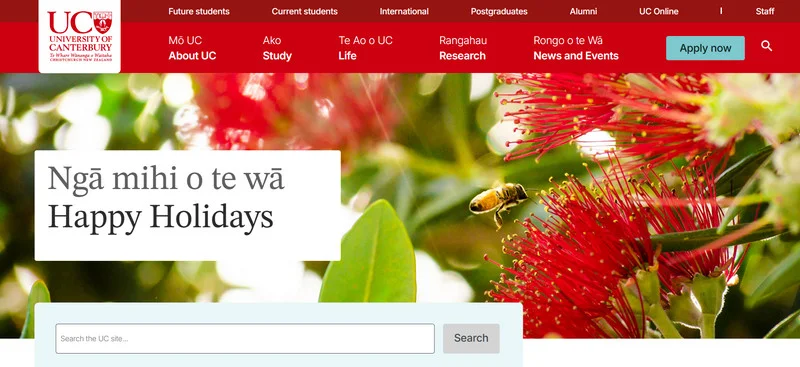
Introduction: Located in Ōtautahi, Christchurch on New Zealand’s South Island, the country’s second largest city, the University of Canterbury offers a unique educational experience. The institution provides students with an abundance of educational, exploring, and recreational activities, as well as all of the comforts of a modern metropolis. It is proud to welcome students and staff from all around Aotearoa New Zealand and the world to learn from one another and contribute to our vibrant and diverse community.
Location: Christchurch (Canterbury, South Island)
Why study here:
- Access to more field stations situated around the country than any other New Zealand university, giving you a unique connection to a diverse natural landscape
- Hands-on learning and practical applications to the real world, with opportunities to take part in projects with industry partners and attend seminars with experts, internships, and field trips
- Various awards, including automatic Dean’s Awards and specific international/adversity scholarships to support students financially
- Joining a whānau more than 140,000 strong, a cohort of engaged and empowered alumni affecting change across the world
University of Auckland

Introduction: The University of Auckland is listed among the top 100 in the QS World University Rankings, making it New Zealand’s highest-ranked university. Renowned for its research excellence, the university is recognized for its strong reputation and achievements in scholarly research, contributing significantly to knowledge and innovation. It has received a five-star plus QS Stars University Rating for excellence in the following categories: Research, Employability, Teaching, Facilities, Internationalization, Innovation and Inclusiveness. With 7,000 international students from over 120 countries, you can join a vibrant and strong community as a new member.
Location: Auckland
Why study here:
- Wide range of more than 200 programmes and subjects with a generous scholarship
- Support for your postgraduate or doctoral research from the research support team at their excellent facilities and research centres, reflecting the university’s commitment to research excellence
- Diverse and inclusive community with clubs and societies in a vibrant campus life
- Future career support by their award-winning Career Development and Employability Service (CDES)
University of Otago

Introduction: The University of Otago was New Zealand’s first university, founded in 1869. As New Zealand’s oldest university, Otago holds the distinction of being the oldest university in the country, with a rich historical legacy and foundational role in New Zealand’s higher education. Over 150 years later, Otago is still a premier university in New Zealand, with a strong history and international reputation for academic achievement. It takes in being a research-led university and ranks first in the country for foreign student learning.
Location: Dunedin (Otago), Wellington & Christchurch (Canterbury)
Why study here:
- Claiming excellent levels of student satisfaction and generates globally employable graduates, with 95% of students going on to further their education or find work
- Close-knit student community and experience, with the main campus located in Dunedin where over 21,000 students are living, working, and learning.
- Various programmes from undergraduate and postgraduate courses to Summer School, Study Abroad, Exchange and Distance Learning programmes
- Sustainability and positive social impact through volunteering and leadership
Victoria University of Wellington
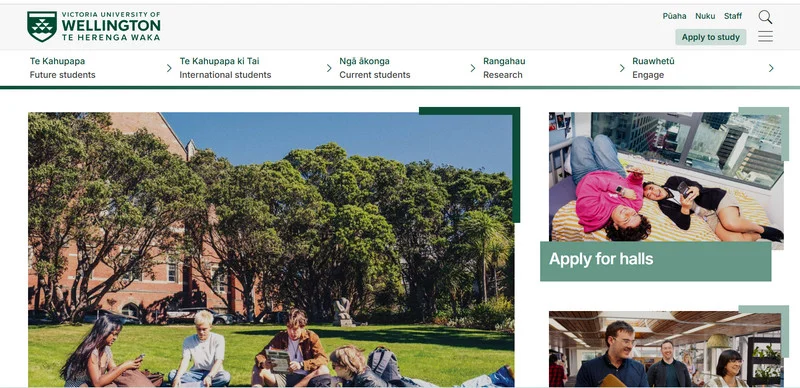
Introduction: Victoria University of Wellington, also known as Wellington Victoria University, has 17,000 students, including 3,000 international students from over 100 countries. Located in New Zealand’s capital city, its goal is to produce graduates who have learned both within and outside of the classroom, via experience, and with a global perspective.
Location: Wellington, New Zealand’s capital city
Why study here:
- Nearly 200 programmes in in-demand areas, along with more than 40 research centres and institutes, including the Antarctic Research Centre and the Centre for Data Science and AI
- Access to diverse national organizations in the areas of business, culture and heritage, government, and politics, etc.
- Strong industry connections that help develop a curriculum that aligns with current industry needs and trends to equip students with the relevant skills and knowledge required in the professional world
- Supportive student services to help you navigate university policies, choose appropriate courses, manage study plans, and address any academic concerns
Southern Institute of Technology

Introduction: Southern Institute of Technology (SIT), founded in 1880, has five campuses and nearly 13,000 students. It provides industry-relevant education, a cheaper cost of living, and a welcoming, close-knit environment. With programs tailored to match real-world job expectations and campuses in calm cities such as Invercargill and Queenstown, SIT provides you with the opportunity to focus and grow.
Location: Invercargill
Why study here:
- 200+ programmes are accredited by the New Zealand Qualifications Authority and link to a variety of job or further education opportunities in New Zealand and abroad
- Safe and friendly location with countless opportunities to meet the locals
- Generous scholarship options for international students help reduce the overall cost of education
- High acceptance rate from approximately 75% to 100% when you submit a complete application with the right documents
Massey University

Introduction: Massey University, with its tradition, diversity of programmes, and flexibility of remote education, allows students from all over the world to personalize their studies to their own needs while also connecting closely with business, professional bodies, and local communities. It is also the leading university in New Zealand for online and borderless education, offering a variety of undergraduate and postgraduate degrees that students can complete entirely online. Massey is the only university in New Zealand offering degrees in veterinary medicine and veterinary science, and is also recognized for its strong programs in social sciences.
Location: Auckland, Palmerston North (Manawatū), and Wellington
Why study here:
- Providing students with a high-quality education that prepares you for prosperous careers and contributes to advancing knowledge in your respective fields
- The hub of research, innovation, and entrepreneurship fosters a dynamic and collaborative environment that supports new discoveries, creative problem-solving, and the development of entrepreneurial abilities
- Collaborations and partnerships with leading universities, research institutions, and organisations worldwide that facilitate student and faculty exchanges, joint research projects, etc.
- Culture of cultural diversity and inclusion, welcoming students from diverse cultural, ethnic, and social backgrounds
Unitec Institute of Technology

Introduction: Unitec Institute of Technology is New Zealand’s largest technical institute, with over 20,000 students, including overseas students from more than 80 countries. It is a member of the International Association of Universities and has official links with numerous institutions throughout the world. For more than 40 years, it has been recognized as one of New Zealand’s pioneering applied education institutes.
Location: Auckland
Why study here:
- The largest training institute in New Zealand, and the only one that offers graduates the opportunity to register with the Osteopathic Council of New Zealand and operate as professional osteopaths
- Offers a range of online courses and flexible learning options, making it easier for international students to study from anywhere
- Outstanding student support services lead to high levels of satisfaction
- Unique combination of world-class theory and hands-on experience to build the skills you need for your career and your future
- Exceptional campuses cutting-edge facilities, including specialised labs, studios, and workshops
Popular Courses for International Students
New Zealand’s universities provide programs to meet a wide range of interests. With globally recognized degrees, research opportunities, and generous scholarships, New Zealand offers international students a diverse selection of academic pathways and support. Some of the most popular programs are:
- Information Technology & Computer Science
- Health Sciences (including Nursing and Medicine)
- Engineering & Architecture
- Business Management
- Education & Teaching
- Sports Science
Now let’s take a look at which university is best to attend based on your major of interest:
| Institutions | Known for |
|---|---|
| Auckland University of Technology (AUT) | Sport Science, Design, Architecture |
| University of Waikato | Business Management, Computer Science |
| Lincoln University | Environmental Science, Agribusiness |
| University of Canterbury | Engineering, Computer Science/IT, and Business/Commerce |
| University of Auckland | Engineering, IT, Medicine, Business |
| University of Otago | Health Sciences, Medicine, Research |
| Victoria University of Wellington | Law, Cybersecurity, Humanities |
| Southern Institute of Technology | Nursing, Agricultural Technology, and Creative Arts (Audio/Music) |
| Massey University | Agriculture, Aviation, Food Technology |
| Unitec Institute of Technology | Applied Tech (IT, Engineering), Health & Nursing, Hospitality |
Admission Requirements to Study at Top Universities in New Zealand
Qualification/Grades Requirements
Academic requirements are the first in the list when you get ready for studying in New Zealand. Your records are not only used for admission but also for scholarships applications. Thus, having outstanding academic merits will give you better chances of being accepted.
Our advice is to set a goal well in advance, preferably when you are in your freshman year of high school. By that, you have lots of time to improve your grades and earn some honors to polish your application.
Now, let’s take a look at the Qualification/Grades requirements to study at top universities in New Zealand:
| Level of Study | Requirement details |
| Bachelor’s degree |
|
| Master’s degree |
|
| PhD |
|
Student Visa Requirements

International students enrolled in courses lasting more than three months must obtain a New Zealand study visa. Meanwhile, students who want to study for a bachelor’s or master’s degree in New Zealand must get a Fee Paying Student Visa.
To apply for a visa, you must submit the following documents:
- Your passport
- A Letter of Offer from a school that has been approved by the New Zealand Qualifications Authority (NZQA)
- Proof of your financial capability to cover living expenses and tuition (NZ$1,667 per month for shorter stays or NZ$20,000 per year)
- A flight ticket back to your own country
- A medical and X-ray certificate
- A police certificate proving your moral fiber
- Your university’s written declaration that it is willing to assume responsibility for you
- Proof that your visa application fee has been paid
- 2 passport-sized photos
English Language Proficiency Requirements
In New Zealand, educational institutions typically require students to verify their English language proficiency through examinations. Here, we will just look at the two most popular examinations chosen by students: IELTS and PTE Academic tests.
The table below indicates which English language tests are approved and what the minimum score is for international students to study in New Zealand.
| Level of Study | Minimum IELTS Score Required | Minimum PTE Score Required |
| Undergraduate | 6.0 with no band less than 5.5 | 50 – 64 |
| Postgraduate | 6.5 with no band less than 6.0 | 58 – 79 |
Other Documents Required to Study at NZ’s Top Universities
There are other important documents required to complete the application process, in addition to those listed above. Try to collect all the following papers to make sure your admission process go smoothly:
- Academic transcripts
- Statement of Purpose (SOP)
- Letters of Recommendation (LOR)
- Resume/CV (for postgraduate courses)
- Achievement certificates for any extracurricular activity
- LOI from your college or school or from two employers if you have prior job experience or are already employed
How to Apply to New Zealand’s Top Universities
Timeline for Intakes in Universities in New Zealand
There are three main intakes in New Zealand, including: February, July, and September. Although these are the primary options, certain educational institutions accept applications all year through rolling admissions. Importantly, for postgraduate levels, some may have tailored start dates for specific courses or offer multiple intakes for specific programs.
Generally speaking, understanding New Zealand intakes will allow you to plan your timetable with remarkable flexibility. So, let’s have a look at our summary of the NZ study intakes and deadlines for each semester:
| Intake | Semester | Deadlines |
| February | Semester 1 (February to June) | Between November (of the previous year) and January |
| July | Semester 2
(July to November) |
Between March and May |
| September/November intake | Trimester 3 | Varies by program |
| Rolling intakes | Various times throughout the year | No deadlines |
For example, the University of Auckland has two primary intakes: Semester 1 (February), which provides the most study options, and Semester 2 (July), which is suitable for mid-year applicants. Yet, several shorter courses and pathways (Foundation, routes Link) have extra intakes in April and October.
Application Process for International Students
For university applications, timing is everything! Do it early and you will be able to get admitted into your favorite course quickly. Thus, we recommend you decide on your university, so you can start the application process as soon as possible.
Once you have finalized your university selection, here is what to do next:
- Step 1: Check for admission requirements
- Step 2: Prepare necessary documents like academic transcripts, passport copy, Statement of Purpose (SOP), Letters of Recommendation (LORs)
- Step 3: Take the English language assessments test
- Step 4: Submit your application online to the university, including application fees if necessary
- Step 5: Apply for a student visa to New Zealand as soon as you have the Letter of Acceptance (LOA)
- Step 7: Gather all the papers required for visa application
- Step 8: Submit & Pay the visa application fee
- Step 9: Confirm your visa approval
- Step 10: Pack your bags and get ready to fly to New Zealand
Life & Study as International Students in New Zealand

Life & Study in New Zealand may be different from what you know in your home country. However, if you prepare yourself to embrace the differences, you can overcome any obstacle to enjoy a high level of life.
Housing & Accommodation Options
There are several types of accommodation choices for overseas students in New Zealand, each with its own set of benefits and drawbacks to consider. We will present you with a closer look at what is available, ranging from the convenience of on-campus living to the independence of private renting.
- On-campus housing/ Halls of residence: Living on campus provides you with easy access to everything you need as a student. It provides completely furnished single or twin-share rooms with a shared dining hall, lounge, and laundry. Furthermore, meals, computer facilities, laundry, and cleaning services are occasionally included in the rent.
- Purpose-Built Student Accommodation: Usually just a walk away from campus, they have modern, dedicated student accommodation, generally with private studios or shared flats, all-inclusive bills (Wi-Fi, utilities), and amenities like gyms/study rooms.
- Homestay: This type of accommodation allows you to reside in a New Zealand family’s home, usually in your own fully furnished room. They’ll feed you and assist you adjust to daily life in New Zealand. This is an excellent opportunity to meet some nice New Zealanders, improve your English abilities, and get a firsthand view at New Zealand’s way of life and culture.
- Private rentals (shared or solo): Living in a privately rented apartment might be very appealing. It allows you to choose who you want to live with and where. Students who choose this form of housing can either move into pre-furnished residences on a room-by-room basis or apply to lease the entire property with individuals they already know.
Overall, it is a good idea to start your student housing search early. Ideally, you should start looking 2 to 3 months before your planned arrival date to give yourself enough time to consider choices and secure a spot.
Health, Wellness & Academic Services
To be an international student in a different country means you may have to deal with loneliness or any issues on your own. Understanding that, many services are operating to help students in many aspects of their life.
For example, you need to maintain a healthy life to pursue your academic goal. So, having good personal wellbeing and health is important. That said, if you may find it hard to do so, here are some services you could try:
- 1737, need to talk?: A free 24–hour phone or text counselling service with trained counsellors for anyone feeling down, anxious, overwhelmed, or depressed
- Lifeline: A free 24-hour phone counselling with qualified counsellors and trained volunteers for anyone who is feeling lonely, sad or bullied, having relationship or work problems
- Healthline: A free 24-hour phone service for health advice and information from a reputable registered nurse.
Besides, if you have trouble with your study or relevant issues like visa help, scholarships, and accommodation assistance, you can find support directly from your university or other academic services.
For example, the University of Canterbury (UC) assists international students through dedicated services such as the UC International College and various UC support teams. They offer help with everything from admissions (via agents/online forms) to wellbeing and academic skills, with key contacts such as the International Relationships Office and student associations (UCSA).
Student Clubs, Communities & Cultural Life
As an international student in New Zealand, one of the exciting aspects of your university experience is participating in the dynamic student life beyond lectures.
Clubs, communities , and extracurricular activities provide possibilities for socialization, leadership development, and personal and professional growth. New Zealand institutions cater to students’ many interests, including sports, culture, and academics. These platforms provide students with chances to develop new skills and enhance their personal growth and a way to build a social network.
Moreover, New Zealand is a culturally diverse country with different ethnic groups. You can enjoy the unique traditions, festivals or cuisine in this beautiful country. Those special experiences will help you broaden your horizons as a global citizen.
PR Pathways for International Graduates in New Zealand
Many international students who enjoy the country’s high standard of living, rich culture, and active job market wish to stay longer. That is why it is critical for anyone considering their future steps to understand how to obtain permanent residency (PR) in New Zealand after studying there.
However, once you have completed your education, you cannot apply for PR immediately. Instead, you must first meet certain criteria, including:
- Transitioning your Student Visa to Work Visa: Most international students begin with a student visa, but once graduated, they will require a post-study employment visa. This allows you to stay in New Zealand while gaining the job experience required for a PR application.
- Fulfilling New Zealand Qualifications Requirements: To be eligible, your qualification must be approved by the New Zealand Qualifications Authority (NZQA). A Level 7 (Bachelor’s degree) or higher typically places you in a strong position. Certain courses (particularly those on the Long Term Skill Shortage List) can help you advance your PR career.
New Zealand universities are known for their strong research focus and emphasis on research and practical learning, which not only enhance academic excellence but also provide students with valuable hands-on experience that can support their PR applications.
While no specific course qualifies international students for PR in New Zealand, certain disciplines of study may provide better pathways to permanent residency due to the high demand for qualified professionals in such fields.
The best option is to complete a qualification that will lead to a position on the Immigration New Zealand Green List. The Green List is divided into two tiers with distinct residency pathways:
- Tier 1 (Straight-to-Residence): For people who have a job offer from an approved employer, occupations in this tier provide a direct path to a resident visa.
- Tier 2 (Work-to-Residence): After two years of employment in certain positions, you may be eligible for a residence visa.
Now, let’s see some of the popular fields that equip you for jobs on the Green List:
- Healthcare & Social Services
- Engineering & Construction
- Information Technology (ICT) & Electronics
- Education
- Trades, Agriculture & Science
Overall, there is no assurance of PR based just in your preferred field of study, but enrolling in these courses at top universities in New Zealand may give you a little competitive advantage in winning the PR status.
Conclusion
Choosing your university is one of the first steps to embark on an academic journey in New Zealand. If you haven’t made up your mind yet, you can consider our list of the best universities in New Zealand for international students.
All the options are popular and prestigious among students. They guarantee to offer you the best study experience ever.
FAQs
1. What is the acceptance rate of the best universities in New Zealand for international students?
Here is a quick look at the acceptance rate of the best universities in New Zealand for international students:
- University of Auckland: 45%
- University of Otago: 58%
- Massey University: 65%
- Victoria University of Wellington: 64%
- University of Canterbury: 50%
- University of Waikato: 72%
- Lincoln University: 60%
- Auckland University of Technology: 50%
2. What is the Cost of Studying in New Zealand Universities?
The cost of studying in New Zealand varies depending on the subject and level. The average number is between $28,500 and $245,200 NZD per year for an undergraduate course. The average cost of a post-graduate course in New Zealand is between $35,800 and $63,750 NZD per year.
3. Which is the most cheap university in New Zealand for overseas students?
- Massey University
- University of Waikato
- Lincoln University
- University of Canterbury

Moni Vuong
PTE Magic
My name is Moni, and I am a seasoned PTE teacher with over 6 years of experience. I have helped thousands of students overcome their struggles and achieve their desired scores. My passion for teaching and dedication to my student’s success drives me to continually improve my teaching methods and provide the best possible support. Join me on this journey toward PTE success!
Related Blog

28 Jan 2026
How To Study In New Zealand As An International Student

28 Jan 2026
How To Find A Job In New Zealand As An International Student

28 Jan 2026
New Zealand Accommodation Guide for International Students
Frequently Asked Questions
What’s the difference between PTE Academic and PTE Core?
What is PTE Exam Structure and Duration?
How is PTE exam scored?
What tasks are included in PTE Academic?
What tasks are included in PTE Core?
How long is the score valid?
Where can I book PTE Academic and PTE Core exams?
How much does the PTE exam cost?
How can I prepare for the PTE Exam?
Subscribe to our newsletter.

PTE Magic Practice Platform is an AI-powered PTE test prep platform that helps you achieve your desired score with exam-like questions, instant AI scoring, and personalised feedback. Achieve your best PTE score with targeted practice and proven strategies.