How To Apply for A Permanent Resident Visa in New Zealand
28 Jan 2026
For many migrants, obtaining Permanent Residency in a new country such as New Zealand is a big milestone – it symbolizes long-term security, travel freedom, and the opportunity to make the new land home. While some may search for the ‘easiest visa’ to enter New Zealand, achieving permanent residency requires a more comprehensive plan that goes beyond initial entry. However, as a migrant, regardless of whether you entered as a skilled migrant, a student who transitioned into residence, or under other categories, it is important for you to understand how the Permanent Resident Visa system works.
This guide will take you through everything you need to know about applying for a Permanent Resident Visa in New Zealand – from the requirements to apply and the different ways you can apply, through to what happens after your application is approved, and the importance of having a plan for your pathway to permanent residence.
Why Permanent Residency in New Zealand Matters
What is a Permanent Resident Visa?
The Permanent Resident Visa is a residence class visa that gives you the authority to stay and live within New Zealand, but without limits or restrictions of any kind related to the dates of your travel. This visa grants you indefinite re-entry rights, meaning you can re-enter New Zealand at any time without restrictions.
However, if you are applying for the Permanent Resident Visa, you must ensure that you have held the resident visa for at least two years before applying. When you have the Permanent Resident Visa, you can stay within New Zealand for whatever period you like.
With some visas, you can return to the country only until a certain date, but with this visa, there is no such uncertainty, and you can stay, work, and study for an indefinite period, and come and go whenever you desire to New Zealand, enjoying the benefit of indefinite re-entry.
Benefits of Permanent Residency
Attaining permanent residency status in New Zealand opens many major doors for immigrants who seek long-term stability and flexibility:
- Unlimited Stay & Travel: Stay in New Zealand for an unlimited period of time and travel out of New Zealand anytime you want.
- Live, Work, and Study: There is no restriction on working and/or studying; all individuals can work/study according to their goals without changing visas.
- Include Family Members: Eligible partners as well as children can be included in the visa application, and each is considered on individual merit.
- Path to Citizenship: Permanent residency is often considered an initial step in seeking citizenship in New Zealand after meeting certain legal requirements.
When you get a permanent resident status, you gain the right to live, work, and travel in New Zealand without any further visa conditions.
Together, these offer advantages that make obtaining permanent residency a significant step for those migrants who view New Zealand as a destination for establishing a future life whether it involves building a family, building a business or profession, or simply enjoying life.
Difference Between Resident Visa and Permanent Resident Visa
A resident visa as well as a permanent resident visa allows you to reside in New Zealand forever, although these two visas have major variations in terms of travel requirements:
- Resident Visa: This will enable you to live, work, and study in NZ forever, but your right to enter and exit NZ will be valid until a certain travel expiry date as contained in your resident visa. These are known as resident visa travel conditions. When your travel conditions expire, you can remain in New Zealand, but you will lose the ability to re-enter the country if you leave. If your travel conditions expire and you are not yet eligible for a Permanent Resident Visa, you may need to apply for a subsequent resident visa or a variation of travel conditions to maintain your ability to return to New Zealand.
- Permanent Resident Visa: There are no travel expiration conditions, so you may enter and exit the country whenever you want, since you can travel only as long as this visa is in your current passport. Because of this, this visa is considered permanent indeed.
Talking plainly, even though both visas give you the right to call New Zealand home for all of your life, only the Permanent Resident Visa allows you to travel abroad as often as you want without considering the travel expiration date of your visa.
Eligibility Criteria for Permanent Resident Visa

If you want New Zealand to become your long-term residence, you must meet an eligibility criteria list before you can apply for a Permanent Resident Visa. This criteria list ensures that you have already adjusted well to living in New Zealand and that you want to make a contribution to this country. It is essential to meet all eligibility requirements before submitting your residence application for a Permanent Resident Visa.
Resident Visa Holding Requirement (2 Years)
In order to be eligible for a Permanent Resident Visa, the first essential criterion is that you must have held a New Zealand resident visa (also referred to as a Zealand resident visa) for at least two years before applying. This means you need to reside in the country as a resident visa holder for a minimum of two years prior to making your application. The mere granting of a resident visa is not sufficient; you must also be a resident of New Zealand for this stipulated duration under a New Zealand resident visa.
Most importantly, this does not necessarily reflect that you are ready for travel rights, which would come with a Permanent Resident Visa, but you must show that you have been a resident of this country for a sufficient amount of time under a resident visa.
Current Resident Visa Status
To further clarify, you must either hold, or have held, a resident visa at the time you apply or very soon before that (for instance, when the terms and conditions of your travel expired after the two years you spent residing in the country as a resident).
Immigration NZ will assess you on the consistency you have shown in respect to your resident status and whether any conditions associated with your resident visa have been fulfilled.
Meeting Resident Visa Conditions
Having a resident visa alone will not qualify you – you will have to prove that you have complied with whatever conditions that visa was accompanied by. Such conditions can include but are not limited to employment obligations and skill-related employment.
Meeting these requirements will prove to Immigration NZ that you have honored the terms of the original visa and that you should be allowed to move forward with pursuing residency.
Good Character Requirement
Like all other long-term visas, there are requirements for holding a good character for the Permanent Resident Visa. This applies in that you must not represent a risk for the security of New Zealand, nor must you hold adverse Immigration or criminal records.
If you are 17 or older, Immigration NZ may ask for police certificates or proof of your criminal history from countries that you have lived in. If you have nothing on record or can adequately explain a less-than-perfect track record, applications are likely to proceed smoothly.
A failure to satisfy the good character requirement can result in an application refusal, although rarely, an application can be assessed for waivers or special directions based on strong grounds.
Commitment to New Zealand
Amongst the most interesting aspects of Permanent Resident Visa requirements, it has to be the commitment requirement. This is not just about being in New Zealand, it is about proving that New Zealand is your home and that it can expect to see you stay for the long term.
There are several ways in which you can show this commitment:
- Time Spent in New Zealand: You’ve been living in the country as a resident for enough days – at least 184 days in each of the two 12-month periods before you make your application.
- Zealand Tax Residence Status: You may also qualify through your Zealand tax residence status, as defined by Inland Revenue, demonstrating your financial ties and commitment to New Zealand.
- Investment in New Zealand: Having a substantial investment in New Zealand (for instance, NZ$1,000,000 or more) lasting a period of two years should help.
- Business in New Zealand: Running or owning a business in New Zealand that contributes to the local economy might also be considered.
- Base in New Zealand: The presence of an established base in New Zealand, such as family, ownership of real estate, employment, and other strong ties, may also serve your purpose.
By satisfying at least one of these requirements, you make it clear to Immigration NZ that you are not only coming to New Zealand but also contributing towards the society and future of New Zealand.
Pathways Leading to Permanent Residence
Obtaining a Permanent Resident Visa in New Zealand is never random; there are several planned processes for migrants belonging to different categories. Most pathways to permanent residence begin with a temporary visa, which allows you to live, work, or study in New Zealand before progressing to a resident visa. Whether you are a skilled worker, a person moving for family reasons or an investor, familiarizing yourself with all the process routes can definitely give you a planned approach and a higher level of probability for a successful application result.
Skilled Migrant Category
Skilled Migrant Category (SMC) is among the most popular migration options for those who have in-demand skills in New Zealand. The process is based on a points system, where you have to fulfill a minimum point requirement based on factors such as work, qualification, wages, and skilled work experience in New Zealand.
Under this pathway:
- Applying for residency is an option if you have enough points for reasons such as having a job offer, qualifications, and experience.
- For some skilled migrant pathways, having a job offer from an accredited employer can be a key requirement.
- Typically, you must show you’re engaged in the activity or have a job offer in a professional capacity.
- After you obtain a Skilled Migrant Category Resident Visa, you are eligible to reside and work permanently, and after that, you apply for residency when the requirements are met.
The SMC is suitable for professionals, engineers, IT experts, health practitioners, and other skilled individuals who already have a route towards skilled employment in New Zealand.
Work to Residence Pathway
The Work to Residence Visa allows you to begin with a temporary work visa and move to a residence visa after acquiring a particular level of work experience in New Zealand. A popular option within this pathway has been the Green List/other sector agreements.
This is how it usually works:
- First, you work in New Zealand on the basis of a work visa in an in-demand profession.
- You then, having fulfilled work requirements, which may typically involve 24 months of full-time work under a valid visa, are eligible for a Resident Visa.
- Once you possess this resident visa long enough and other requirements (such as residency and good character) are met, you are eligible to apply for Permanent Residence.
This is particularly beneficial for foreign workers who can secure long-term employment in areas where New Zealand requires workers. These areas refer to job gaps in the New Zealand workforce.
Straight to Residence Pathway
In some cases, especially involving people who are in critical occupations in New Zealand, there is a quick pathway called the Straight to Residence Visa. This visa allows eligible applicants to apply for residency immediately, without first having to work under a temporary or residency visa for several years.
Important aspects of the Straight to Residence Visa pathway are:
- It is normally associated with Green List Tier 1 jobs, which belong to high-priority jobs that New Zealand is short of.
- But if your job offer satisfies the requirements for qualification, wages, and registration, then you would have a right to apply for residence, either from overseas or otherwise.
- After acquiring residence in this way and fulfilling the residence requirements later on, you can then seek permanent residence.
This option appeals particularly to highly skilled individuals, which can help to cut down the time taken to settle permanently in New Zealand.
Family and Partner Categories
In New Zealand, residence is not only reserved for applicant workers or investors but can similarly be acquired through familial ties. These are:
- Partnership Pathway: If you’re a partner or dependent of a New Zealand citizen or resident.
- Dependent Children Pathway: Children of residents or citizens satisfying particular age and dependency qualifications.
- Other Family Categories: There could be other family categories, such as parent visas, that are eligible within specified criteria.
These residency routes allow members of families to apply and remain within New Zealand on the basis of their connection with a relative who is a resident within the country. After residing within the country and meeting residency criteria, they can then apply for residency just like other residence holders.
Business and Investment Pathways
Entrepreneurs and investors are offered a special route by New Zealand through which economic contributions may result in residence:
- This Working Visa for a Business Investor, launched recently, enables qualified businessmen to invest in a New Zealand business and work in the country for up to four years.
- Depending on the investment amount:
- The NZD$ 1 million investment: usually a three-year work to residence pathway.
- The NZD $2 million investment: usually results in a quicker path to residence within one year.
- After satisfying business and residence requirements, applicants can apply for a Business Investor Resident Visa and eventually obtain permanent residence.
These investment avenues lure international entrepreneurs and talented investors to settle in New Zealand and help its economy in the process.
Other Residence Pathways
Apart from these general categories, there are some special or developing streams of resident visas, which could be relevant depending on any agreed sectors and/or government decisions:
- There are agreements within sectors like care workforce or transport sectors; these agreements can fast-track the route to residency after working in the country for a required number of years.
- The immigration policy is ever-changing, with new immigration categories being created from time to time to cater to the needs of the labor market, such as trade workers, local NZ qualification holders, or strategic skills.
These “other” streams thus provide an opportunity for various migrants to contribute to New Zealand in different ways and ensure that individuals who can provide value to New Zealand can call it their home.
Application Process Overview
Completing an application for a Permanent Resident Visa in New Zealand is an organized process whereby Immigration New Zealand helps determine if an individual has satisfied all the criteria, right from being eligible to being of good character and intending to reside within the country. This article outlines in detail what an individual needs to do when applying for this type of visa.
Step 1 – Check Eligibility
Before applying, please ensure that you are eligible on the basic criteria to apply for a Permanent Resident Visa. This will involve having held a resident visa for at least two consecutive years and complying with conditions attached to the resident visa. In addition, you should demonstrate allegiance to residing in New Zealand.
Early eligibility checks also prevent you from experiencing delays or having to withdraw your application and reapply later.
Step 2 – Gather Required Documents
Once you determine that you qualify, it is time to start collecting documents. Common documents needed are:
- Copies of your passport and residency visa
- Evidence of meeting the terms of your resident visa
- Identity Documents
- Police certificates (if required)
- Evidence of your commitment to New Zealand
- Translations for documents not in English
Ensure that all papers are complete, valid, and well-organized. Incomplete papers may cause delays during processing.
Step 3 – Prepare Evidence of Commitment
Among the important factors that must be met for residency, prove that New Zealand is your long-term residence by:
- Records of time spent living in the country
- Employee or business files
- Tax residency documents
- New Zealand – Evidence of Family Ties or Property
If you have well-prepared commitment evidence, it will serve to strengthen your application and will demonstrate to Immigration New Zealand that you have a commitment to staying in New Zealand on a permanent basis.
Step 4 – Good Character Evidence
Applicants must all be of good character if they want a visa issued. For most applicants, this entails getting a police certificate, especially if they have resided in another country for a considerable number of years. A certificate must not be over 6 months old from the date you process your application.
It is essential to make known any legal problems, visa refusals, and deportation incidents in your life honestly, as hiding can result in disqualification.
Step 5 – Complete the Application Form
When you have your documents together, you can move on to completing the formal application form for the Permanent Resident Visa. This form requires all of the personal information you have and all of the information you have listed as evidence supporting your visa application.
Be sure you:
- Provide all required details
- Provide accurate and truthful information
- All English on your form and documents please
Any mistakes or missing information may cause delays or rejection.
Step 6 – Pay the Application Fee
Once you have finalized your application form, you are required to pay the required application fee for it. The cost of the form depends on where you are applying from and how you are submitting the form. This information can always be found on Immigration New Zealand’s official website.
If it’s an online application, there will be the option to pay while completing the form.
Step 7 – Submit the Application
After making the payment, the next step involves submitting your application. In most cases, applicants usually apply online through the Immigration New Zealand website, where one can upload their supporting documents.
When applying through the postal system, you should ensure that all application forms are fully completed and that your mailing labels are correct.
Step 8 – Wait for Decision
After that, your application will be processed by Immigration New Zealand. In the case of a Permanent Resident Visa, the processing times usually remain short, just a couple of weeks, compared with other resident visas.
When this stage is reached, you may also be asked for further information or paperwork. It is important to be timely in answering these communications.
Required Documents
While applying for a Permanent Resident Visa under New Zealand immigration law, you are required to provide a list of important documents that validate your identity and residence status, as well as confirm you are of good character and intend to live in New Zealand. Preparing all necessary documents before submitting applications may prevent a delay or asking for additional information.
Passport and Identity Documents
Your passport is the backbone of your application because its contents verify your identity and nationality. Make sure your application includes:
- Valid passport, copy of photo page and passport details.
- Any travel documents if you do not have a passport, such as a certificate of identity.
It is essential to ensure your passport has an exact minimum period of validity after your trip. In fact, it is always recommended to have a longer period of passport validity. Immigration New Zealand will make use of your passport to verify your travel records and your residency stamps.
Resident Visa Records
To prove that you satisfy the primary requirement for residency, you need to provide information and proof about your current or previous residency under the following:
- A clear copy of your existing resident visa label or eVisa.
- Documents showing when your Resident Visa started and under what conditions you were granted residence.
- Proof of having maintained your Resident Visa for the necessary period of time (at least 2 years).
It also proves that you have fulfilled the minimal residency requirement before qualifying for residency.
Commitment Evidence
One of the most essential components when applying to those scholarships is to highlight your ties to New Zealand, namely to prove that New Zealand will be your long-term home. Such evidence can be:
- Travel history indicating residence in New Zealand for a specified time period (e.g., passport).
- Employment or income evidence from work that you have done in New Zealand.
- Tax records showing tax residency in New Zealand.
- Evidence of business and/or property connections in New Zealand.
This information is utilized by Immigration New Zealand to ascertain that you have a genuine intention to remain in New Zealand permanently.
Police/Character Certificates
Possibly, you might need to show that you’re a person of good character, which means that you do not constitute a threat to the safety of New Zealand. This requires that you:
- Police certificates issued in your country or citizenship and any other country you have lived in for a period of 12 months or more in the preceding 10 years. Normally, police certificates cannot be older than 6 months when submitted.
- Being truthful about previous convictions, deportations, and immigration matters.
Even if Permanent Resident Visa applications have previously used the results of character checks as part of your residency visa, Immigration New Zealand may still request police certificates as needed.
Translations (if applicable)
All documents that are not in English must be translated. What that means is that:
- The translated text should be clear and precise.
- In translation, it should contain the name, contacts, as well as qualification/certification of the translator.
- It must be filed together with the original document.
Inadequate translation of the documents may cause delays or requests for re-submission; you can therefore ensure that the translation is thorough before applying.
Applying Online
The process of applying for a Permanent Resident Visa in New Zealand can now be done completely online, and this offers you the ability to complete all of the major steps of an application once you have created an account all the way through to uploading documents and fees through Immigration New Zealand’s online system.
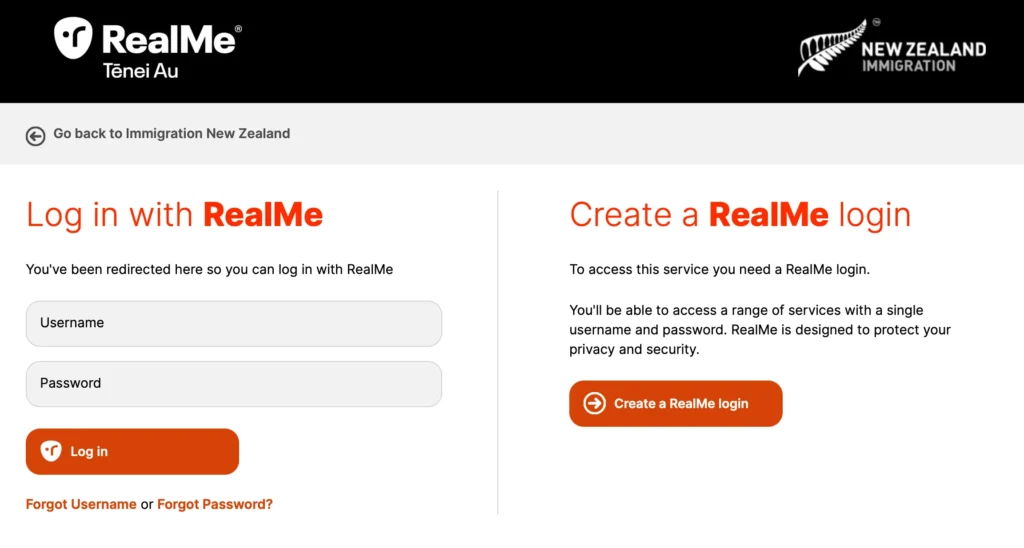
Creating and Using an Immigration Online Account
To start filling out the online application, you are required to create an Immigration Online account. With the account, you will have access to applying, checking application progress, as well as interacting with Immigration New Zealand.
Here’s how it works:
- RealMe Login: To access Immigration Online, create or use a RealMe account, a validated login method utilized by numerous New Zealand government services. This guarantees that your identity is verified and safeguards your private data.
- Accessing the System: After logging in, you can begin your application and select the appropriate visa type (such as a Permanent Resident Visa). Forms specific to your visa category and customized checklists will be available to assist you in obtaining all required data and supporting documentation.
- Tracking Progress: Following submission, your account allows you to monitor the progress of your application, view any messages from INZ, and reply to inquiries for additional details, keeping you informed at all times.
The process of applying for most Permanent Resident Visas is done online, but some applications can be submitted manually.
Uploading Documents
Once your application starts processing, you will have to submit supporting documentation through an online account. The Immigration Online system enables you to upload all of your documentation electronically, which is a major benefit compared to other paper-submission methods.
Here’s what you should know about uploading:
- File Formats: Common formats for document files include PDFs. Make sure the photographs submitted can be read clearly. This is further clarified in the guides on Immigration NZ’s website.
- Organize Docs Well: Before you upload documents to INZ, it is important to organize them in a manner such as: identity documents, residence visa history, evidence of commitment, character certificates, and so forth.
- Cover Letters or Explanations: If a document requires context (for example, a gap in travel history or a foreign qualification), an explanation file needs to be submitted. Immigration Online enables the uploading of these documents together with your documentation.
First, by uploading, you prevent possible delays associated with mailing physical files, as all evidence will instantly be accessible to the processing team at INZ.
Paying Fees Online
When you’re finally ready to submit your application, Immigration Online also enables you to pay your visa fees online, and this process does not involve going to the bank or making use of other transfer systems.
Key things to know about paying online:
- Secure Payment: The platform protects your financial information by processing your payment through secure systems. Your receipt is kept in your online account for future reference after payment.
- Updated Fees: Visa fees, including any associated immigration levies, depending on your circumstances and nationality, are to be checked in the fees and levies page of the Immigration New Zealand website before payment.
- Prior to Applying: You will typically only need to pay when your responses and paperwork are complete but make sure to check everything before paying, as fees become non-refundable if you decide to withdraw or reapply.
After you’ve paid and submitted your application, you will receive notification in your online account and by email and at this point, you can sit back and wait to see what happens as Immigration NZ processes your application.
Processing Times and What to Expect
Of the many questions that applicants ask when processing their Permanent Resident Visa in New Zealand, one that puzzles many of them is: How long will the process take? Although each case is different, Immigration New Zealand (INZ) gives information to help you get an idea of the average processing times and the factors that may affect the process time.
Standard Processing Timeframes
PRV applications are usually some of the fastest to have been processed compared to other residence visas. According to the latest figures obtained by Immigration NZ:
- About 50% of Permanent Resident Visa applications take around 1 week.
- About 80% of applications can be processed in 2 weeks.
This quick processing rate of the application reflects the fact that this type of visa will be relatively less complex as the applicants will typically have already held a Resident Visa.
However, please note that these times are approximate and based on recent decisions and can alter marginally depending upon INZ and your application..
Checking Application Status
Once you have applied online, it is simple to follow the progress, as:
- Log in to your Immigration Online account – this is where you previously submitted your application.
- You can check if a case officer has been allocated, more information sought, or a decision has been made.
- You will also receive an online account or email notice when additional documentation or clarification is required by Immigration New Zealand.
The importance of the completeness and accuracy of the application cannot be overemphasized by INZ because this can also affect the time taken to process visas, whether there is additional information required, or what may be missing in the application.
Possible Delays
Although many Permanent Resident Visa applications take just a few weeks to process, the following factors may cause a delay in the application process:
- Incomplete documentation: Where evidence is missing, requests for further information may be generated, and this may increase the timeline.
- Character or health checks: If INZ requires police certificates or more information on character or health, this could take weeks.
- Periods with high workloads: The level of incoming applications may vary depending on trends in immigration, public holidays, or seasons that may cause a slightly delayed processing period.
- Application complexity: If there are any unusual circumstances throughout your history, such as gaps in travel or previous visa problems, it might take a longer period for INZ to assess them.
If it appears that it is taking longer than the usual processing times, you can get further information from INZ via your online account.
Including Family Members
One of the most significant advantages of adjusting to the New Zealand lifestyle is the ability to sponsor your family members in your immigration process. Whether it’s a Permanent Resident Visa or residence visas prior to the PR Visa, Immigration New Zealand gives partners and children who are your dependents the opportunity to accompany you into New Zealand so you can start your new life together as a family in New Zealand.

Partner and Dependent Child Inclusion
You may, when applying for the Permanent Resident Visa, extend the application to include your spouse/partner and dependent children, who are granted the privilege to reside, work, and/or study in New Zealand depending on the visa type applied for during the approval process. A dependent child includes anybody who is not married and must not be older than the age of 24 years.
To involve your partner and/or children in the application for residency, you’ll answer “Yes” to the question asking if there are other applicants. Their passport information needs to be provided during the online application process. Furthermore, Immigration NZ will also consider them when they assess your application.
Particularly for partners, you’ll need to show that your relationship is sincere and stable. This could include proof of your cohabitation, shared finances, shared commitments, or other indications of your partnership.
Including families in your residency application gives the advantage that, upon acquiring residency in New Zealand, spouses/partners and children are able to live in the country without limitations on how long they should stay, just like you.
Independent Assessment for Each Included Person
Although you put in one application as the primary applicant, every family member entered will have their credentials evaluated separately. This means Immigration NZ will check the following:
- All included individuals meet health and character criteria which may include police and medical clearance.
- “Dependent,” in regards to age and dependency, exactly applies to children.
- Partners meet relationship criteria when applicable (e.g., relationship is genuine and stable).
If the family member does not fulfill these requirements, they may be left out of the decision, even if your visa application has been approved, so ensure that comprehensive proof supporting all family members has been prepared.
Non-Principal Applicants
Relatives included in your visa application are referred to as non-principal applicants – indicating that they are relying on you as a principal applicant yet have their own eligibility status. Every non-principal applicant must:
- Submit their own identity documents and bio-data.
- Meets good character and health standards (as required).
- Must have appropriate evidence regarding the relationship of dependency or partnership.
At times, especially when the relationships involve elderly individuals or involve circumstances which can be considered complicated (such as joint custody in split families), other supporting documents such as legal guardianship may be required.
Once approved, the non-principal applicants are entitled to the same residency conditions as the principal applicant, including the ability to stay, study, and work in New Zealand, which can eventually lead to residency, if applicable.
After You Apply
Once you have applied for your Permanent Resident Visa, you might wonder what follows, including getting approved and going about planning your life once you arrive and settle into life in New Zealand. These are the things that happen after you apply:
Visa Approval and eVisa
After Immigration New Zealand (INZ) evaluates your application and accepts your Permanent Resident Visa, you will receive an alert about it through your Immigration Online account. This will enable you to receive an eVisa, which will automatically be linked to your passport. This will allow you to confirm your immigration status whenever you are entering New Zealand or when transacting business with employers or financial institutions.
Ensure you list a valid passport in your application because you are using it for visa purposes. Moreover, if you know that your passport expires before or after approval, you may have to transfer the visa into another passport in order to travel abroad.
Travel Conditions
Indeed, one of the most important benefits of a Permanent Resident Visa is that this visa is free from travel requirements. This means that:
- You can come and go as you wish in New Zealand without any time limit on your re-entry visa.
- There is no need to apply for an extension of travel conditions, which are mandatory for regular resident visas.
- When the passport is set to expire, just transfer the visa to a new passport.
It is this freedom that truly enables the visa to be considered permanent, as you can settle in New Zealand without having to consider the possibility of returning elsewhere.
Living, Working, and Studying in NZ Indefinitely
You can stay in New Zealand indefinitely with your Permanent Resident Visa; there is no time limit or set expiration date. You can also:
- Don’t need additional work visas to work in any industry or job.
- Learning at every level of education, including language learning and degree attainment.
- Have access to many social services and benefits like those afforded to local citizens (within terms and conditions).
Unlike temporary visas, Permanent Resident status provides full flexibility to build your career, get more education, or even begin a business, all the while knowing that you do not have to apply for renewal of your immigration status.
Transition to New Zealand Citizenship
The advantages of holding a Permanent Resident Visa can lead one to the next step of applying for New Zealand citizenship. Although this is a process in itself, individuals choose this option once they qualify. Generally, to become a citizen by grant, you must have:
- Resided in New Zealand for a minimum of five years, spending enough time there in person.
- Intended to stay in New Zealand.
- Possesses English language skills and has sound character.
New Zealand is also a country that recognizes dual citizenships; therefore, you do not need to renounce your citizenship when you become a New Zealand citizen.
Common Challenges & Tips
Applying for a Permanent Resident Visa in New Zealand can be an exciting step toward your future but it’s also a detailed immigration process with strict requirements. Preparation and the avoidance of common pitfalls go a long way between a successful and smooth process and a failed attempt. Some common challenges applicants experience, and some advice that can help, are listed below.
Meeting the Commitment Requirement
One of the essential eligibility criteria for holding a Permanent Resident Visa is the commitment that an individual must show to New Zealand. This is more than just being a resident of the country, as an applicant must show that New Zealand is their home. This criterion, for instance, requires that an applicant has been in the country for at least 184 days in the 2 years preceding the time of the application as one of the means for fulfilling the commitment criterion.
Common challenges faced by job applicants:
- Insufficient physical presence: Some applicants underestimate how strict the day-count rules are. Just being a resident visa holder isn’t enough — you must meet the exact thresholds.
- Incomplete evidence: Documentation like travel records, employment contracts, rental agreements, or tax residency evidence must clearly support your time in New Zealand. Weak or missing evidence can lead to delays or rejection.
Tips to stay on track:
- Use passport stamps and travel history to accurately log your time in New Zealand.
- Include employment records, tax documents, school enrollments, or proof of ongoing residence to support your case.
- If you had to spend extended periods overseas for work, illness, or family reasons, prepare clear explanations and supporting evidence.
Being proactive to gather substantial evidence of commitment will enable INZ to consider you one of the locals and not just a transit passerby.
Handling Document Translations
All documents that are not in English must be translated before being submitted – although this is a formal requisite when submitting applications for residence and permanent residence.
Common challenges:
- Uncertified Translations: For applications for Permanent Residency, English translations MUST be provided for all supporting documents which are not in English. These may include birth certificates, marriage certificates, police certificates, and educational qualifications.
- Translator credibility: Immigration NZ does not accept translation done by the applicant or his/her relatives. They need professionals or certified translators, which the applicant can prove that the translation is accurate.
Tips for smooth processing:
- Employ a reputable translation service or a licensed professional for document translations.
- Make sure the translation includes the name of the person doing the translation, contact information, and a certification of accuracy:
- When applying for citizenship through an online process, make sure to scan your original and translation versions clearly, to enable Immigration NZ to easily match them.
It will ensure that relevant documents are not subject to re-submission or delayed processing.
Avoiding Application Errors
Even small errors in your application may delay the process or even result in an application denial. This is due to errors, inconsistencies, or missing data.
Typical errors to watch out for:
- Inconsistent personal details: Simple mismatches — like variations in name spellings or passport numbers — can trigger confusion or requests for clarification.
- Incomplete responses: Skipping questions or not providing complete responses (especially regarding personal characteristics, health issues, or travel experiences) may result in disqualification or supplemental information requests.
- Incorrect visa selection: Choosing the wrong visa category or misunderstanding eligibility rules can derail your application before it’s even processed.
- Omitting key information: Failure to disclose visa refusals, minor offenses, and travel out of NZ may amount to giving false or misleading information and may result in refusal or may influence future applications.
Tips to avoid mistakes:
- Double-check every field on your application form for accuracy.
- Enter personal information exactly as found in your passport.
- Ensure you include extensive evidence and attach it properly during the online application.
- If there are uncertainties in complex matters such as previous character issues, professional advice within the immigration field may be warranted.
Always take the time to carefully prepare your application before submitting it. This way, you can avoid submitting applications that may end up being delayed or denied and thus make your process of becoming a permanent resident easier.
FAQs
Do family members automatically get permanent residence just because the principal applicant is approved?
No, each nominated family member (partner/spouse and/or dependent children) is assessed separately for criteria such as maintaining a residence visa and being of good health and character. Application to include them as dependents doesn’t necessarily mean they are granted approval.
Are health requirements needed for the Permanent Resident Visa?
Yes-, as in all residence schemes, applicants are required to meet health requirements. Another aspect that is not always stressed in the general explanation is that medical examinations may also be necessary, especially when one is asked to provide fresh health certificates or when one has had health problems in the past.
Are English tests (IELTS or PTE Academic) required for this visa?
In contrast to other ways of obtaining immigration, there is no English language requirement for the Permanent Resident Visa application as a prerequisite for obtaining this visa because the criteria for this visa apply to previous residence. (Note: English tests may apply for some resident visas but not as a prerequisite for permanent residency.)
Conclusion
In fact, the process of applying for a Permanent Resident Visa in New Zealand is not just a matter of filling out the necessary documents, but rather the final process to ensure that the period you spent in this country will not be temporary, but rather a permanent one that lies before you.
After approval, as a permanent resident, you will have the right to stay, work, study, and travel in the country unrestricted, besides providing a future opportunity for citizenship in New Zealand. Immigration rules keep varying from time to time, so it is important to get updated information from Immigration New Zealand before applying for residency. Proper planning and understanding of the application procedure will help you achieve a permanent residency status, which can ensure a promising life in New Zealand.
Related articles :
- PTE For New Zealand: Everything You Need to Know
- Post Study Work Visa in New Zealand for International Students
Source:
- https://www.immigration.govt.nz/visas/permanent-resident-visa/
- https://www.immigration.govt.nz/live/resident-visas-to-live-in-new-zealand/permanent-residence/becoming-a-permanent-resident-of-new-zealand/
- https://www.govt.nz/browse/immigration-and-visas/get-a-visa-to-work-in-nz/work-that-leads-to-residence/
- https://www.gov.uk/guidance/living-in-new-zealand
- https://www.newzealandshores.com/permanent-residency/

Moni Vuong
PTE Magic
My name is Moni, and I am a seasoned PTE teacher with over 6 years of experience. I have helped thousands of students overcome their struggles and achieve their desired scores. My passion for teaching and dedication to my student’s success drives me to continually improve my teaching methods and provide the best possible support. Join me on this journey toward PTE success!
Related Blog

28 Jan 2026
How To Study In New Zealand As An International Student

28 Jan 2026
How To Find A Job In New Zealand As An International Student

28 Jan 2026
New Zealand Accommodation Guide for International Students
Frequently Asked Questions
What’s the difference between PTE Academic and PTE Core?
What is PTE Exam Structure and Duration?
How is PTE exam scored?
What tasks are included in PTE Academic?
What tasks are included in PTE Core?
How long is the score valid?
Where can I book PTE Academic and PTE Core exams?
How much does the PTE exam cost?
How can I prepare for the PTE Exam?
Subscribe to our newsletter.

PTE Magic Practice Platform is an AI-powered PTE test prep platform that helps you achieve your desired score with exam-like questions, instant AI scoring, and personalised feedback. Achieve your best PTE score with targeted practice and proven strategies.